Motorsport
Aston Martin at Le Mans: the 1959 win and the DBR1
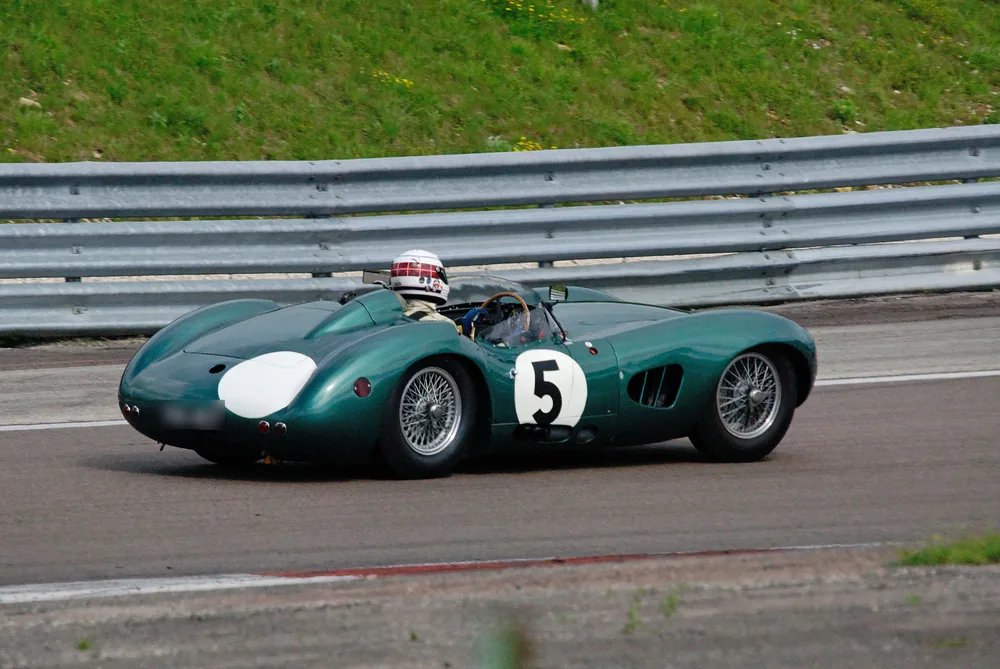
Aston Martin has won Le Mans outright once, on 20 to 21 June 1959: the number 5 DBR1 of Roy Salvadori and Carroll Shelby covered 323 laps and led home a sister car for a one-two finish.
By the My Hangar editorsPublished 6 min read
Key takeaways
- Aston Martin's only outright Le Mans win came on 20 to 21 June 1959, with Roy Salvadori and Carroll Shelby in the number 5 DBR1.
- The winners covered 323 laps and 4,347 km at an average of 181 km/h, according to the race organiser.
- Maurice Trintignant and Paul Frère finished second in another DBR1, one lap behind, for a one-two finish.
- Ted Cutting designed the DBR1, and five chassis were built by 1959.
- Le Mans helped Aston Martin take the 1959 World Sportscar Championship, the only one it has won.
Aston Martin has won the 24 Hours of Le Mans outright just once, on 20 to 21 June 1959. Roy Salvadori and Carroll Shelby took the number 5 DBR1 through 323 laps and 4,347 km at an average of 181 km/h. Maurice Trintignant and Paul Frère finished a lap behind in another DBR1, completing a one-two.
How many times has Aston Martin won Le Mans overall?
Once. The race organiser, the ACO, describes 1959 as the marque's only outright victory. It came after more than 30 years of trying, beginning with two cars that both retired in 1928. In 1931 Gus Bertelli and Maurice Harvey gave it a first top-five finish and class win.
The team came close repeatedly. The DB3S finished second three times in the 1950s, and the DBR1 had already failed to finish in 1956, 1957 and 1958.
| Year | Car | Drivers | Result |
|---|---|---|---|
| 1935 | Ulster | Martin, Brackenbury | 3rd; first podium |
| 1951 | DB2 | Macklin, Thompson | 3rd; first post-war podium |
| 1955 | DB3S | Collins, Frère | 2nd |
| 1956 | DB3S | Collins, Moss | 2nd |
| 1958 | DB3S | Peter and Graham Whitehead | 2nd |
| 1959 | DBR1 | Salvadori, Shelby | 1st |
What was the Aston Martin DBR1?
A purpose-built sports-racing prototype, designed by Ted Cutting. Aston Martin says new rules for 1956 allowed it to build a true racer rather than a car based on a production model.
It had a multi-tube chassis and torsion-bar suspension. The all-aluminium straight-six started at 2.5 litres, 2,493 cc, and grew to 3 litres, 2,992 cc, the limit the ACO set from 1958. Wikipedia rates that engine at 250 hp. Five chassis had been built by 1959.
The first race went badly: a single car entered Le Mans in 1956 and retired with gearbox failure. The car began winning in 1957, at Spa and the Nürburgring, and took the Nürburgring 1000 km three years running from 1957 to 1959. But its gearbox remained what Motor Sport calls its Achilles' heel.
What changed for 1959?
The ACO added a preliminary test day, and Aston Martin used it to improve the gearbox and the aerodynamics. Motor Sport records a lower front, a raised rear, quick-release rear spats and a plastic cover over the passenger seat. The exhausts were routed differently too, which spared the drivers noise but burned Salvadori's feet.
How did Aston Martin win Le Mans in 1959?
By lasting. Three works DBR1s started, with a privately entered fourth for Graham Whitehead and Brian Naylor. General manager John Wyer set the pace for the cars that survived, and the Ferraris faded.
Stirling Moss and Jack Fairman ran the number 4 car with a more powerful engine, at Moss's request. Moss led from the start and fought with Jean Behra's Ferrari, but the car retired in the sixth hour with engine trouble after 70 laps.
Behra and Dan Gurney's Ferrari lasted until the tenth hour. Phil Hill and Olivier Gendebien then took control, and by 5am they were three laps ahead of the number 5 Aston. Their Ferrari overheated and stopped on the Sunday with less than five hours left, handing the lead to Salvadori and Shelby.
Was the winning drive really that hard?
Yes. Salvadori drove for 14 hours with flu, according to the ACO. Shelby had a stomach illness, reported by the ACO as dysentery. Trintignant, in the second car, burned his foot on an overheated accelerator.
The winning car also lost time when a damaged tyre set up a vibration, which Salvadori took for a gearbox problem. Motor Sport estimates that cost 12 to 15 minutes. Shelby took the chequered flag.
| Pos | No. | Drivers | Car | Laps |
|---|---|---|---|---|
| 1 | 5 | Salvadori, Shelby | Aston Martin DBR1/300 | 323 |
| 2 | 6 | Trintignant, Frère | Aston Martin DBR1/300 | 322 |
| 3 | 11 | "Beurlys", "Eldé" | Ferrari 250 GT LWB | 297 |
| 4 | 18 | Pilette, Arents | Ferrari 250 GT | 296 |
| 5 | 16 | Grossman, Tavano | Ferrari 250 GT California | 294 |
Motor Sport identifies the winner as chassis DBR1/2, the second car as DBR1/4, and Moss's car as DBR1/3.
Did the 1959 win give Aston Martin the world championship?
Yes, after one more race. Only the best three of five rounds counted. Moss had already won the Nürburgring 1000 km with Fairman, and Le Mans put Aston Martin on 16 points to Ferrari's 18.
That set up the Goodwood Tourist Trophy, where the Salvadori and Moss car caught fire in the pits when fuel hit a hot exhaust. Whitehead withdrew his own delayed DBR1 so that the works team could use his pit. Moss took over the car that Shelby and Fairman had been sharing, and it won a lap ahead of a Porsche.
Aston Martin finished on 24 points, against a net 18 each for Ferrari and Porsche. It is the only World Sportscar Championship the marque has won.
What happened to the DBR1 and the team after 1959?
Aston Martin withdrew from sports car racing to concentrate on the DBR4 grand prix car, which never matched the DBR1's success. A privately run DBR1 still took third at Le Mans in 1960, with Salvadori sharing with Jim Clark.
Shelby stopped racing a year after his win, following an angina diagnosis, and went on to run Ford's first two Le Mans winners in 1966 and 1967. The first DBR1, chassis DBR1/1, sold for $22,555,000 in August 2017, a world record for a British-made car at the time.
The DBR1 carries David Brown's initials, as explained in What DB stands for. You can put it in context on the My Hangar Aston Martin timeline, or test your racing memory in the My Hangar Aston Martin quiz.
FAQ
How many times has Aston Martin won Le Mans?
Once overall, in 1959. The race organiser calls it the marque's only outright victory, earned by Roy Salvadori and Carroll Shelby in a DBR1.
Who won Le Mans in 1959?
Roy Salvadori and Carroll Shelby won in the number 5 Aston Martin DBR1, completing 323 laps and 4,347 km. Maurice Trintignant and Paul Frère finished second in the number 6 sister car.
Who designed the Aston Martin DBR1?
Ted Cutting designed the DBR1. It was a racer built for new rules introduced for 1956, with a multi-tube chassis and an aluminium straight-six that grew from 2.5 to 3 litres.
How much is an Aston Martin DBR1 worth?
Chassis DBR1/1 sold for $22,555,000 at auction in August 2017, then a record for a British-made car.
Sources
- 24 Hours of Le Mans, Nine 9s: the 1959 race, 24h-lemans.com
- Aston Martin at the 24 Hours of Le Mans: milestones 1928-1982, 24h-lemans.com
- A decade-long ascent that took Aston Martin to the 24 Hours of Le Mans summit, 24h-lemans.com
- The untold story of Aston Martin's journey to Le Mans victory, Motor Sport
- How the DBR1 gave Aston Martin the 1959 World Sportscar Championship, Goodwood Road & Racing
- Le Mans 24 Hours 1959 results, Racing Sports Cars
- DBR1, Aston Martin
- Aston Martin DBR1, Wikipedia
Every figure here was checked against at least two independent sources, listed at the end.