History
What does DB stand for? David Brown and the Aston Martin DB cars
DB stands for David Brown, the Huddersfield gear and tractor maker who bought Aston Martin in 1947 for £20,500. His initials ran from the DB2 of 1950 to the DBS, then returned with the DB7.
By the My Hangar editorsPublished 5 min read
Key takeaways
- DB stands for David Brown, the Huddersfield industrialist who owned Aston Martin from 1947 to 1972.
- Aston Martin dates the announcement of the purchase to Valentine's Day 1947 and puts the price at £20,500; some accounts give £20,000.
- The 2-Litre Sports of 1948 was only called the DB1 retrospectively, after the DB2 arrived in 1950.
- Brown sold the company in 1972, and the initials did not return until the DB7, which entered production in 1994.
- Aston Martin went from the DB7 straight to the DB9, passing over the number 8.
DB stands for David Brown, the Huddersfield gear and tractor maker who bought Aston Martin in February 1947 for £20,500. His initials reached the road on the DB2 of 1950, and the earlier 2-Litre Sports became the DB1 only in hindsight. Brown sold up in 1972; the letters came back with the DB7, shown in 1993.
What does DB stand for on an Aston Martin?
The letters are the initials of David Brown. He was not a founder of the marque, which predates him by decades, but the owner who gave it its post-war identity.
Brown was born in 1904 at Park Cottage, on the site of the family's Park Works in Huddersfield. His grandfather had started the gear business in the town in 1860, and David joined as an engineering apprentice in 1921. Aston Martin's own history says he built his first car at 17, fitting an engine and gearbox to a chassis he welded himself.
Tractors made him a national name. In 1936 he began building Ferguson tractors in a corner of the gear factory. After falling out with Harry Ferguson he launched his own David Brown tractor in 1939, taking orders for 3,000 at the Royal Show in Windsor.
How did David Brown come to buy Aston Martin?
He answered a newspaper advertisement for a "High Class Motor Business". Aston Martin dates the announcement to Valentine's Day 1947 and gives the price as £20,500. Motor Sport and Silodrome give £20,000.
What he got was thin. Motor Sport notes that the only current model was the experimental Atom, designed before the war. Its four-cylinder engine was not going to be enough for the cars Brown had in mind.
So he also bought Lagonda, for £52,500, which Motor Sport describes as more than double the Aston Martin price. Accounts differ on whether that happened in 1947 or 1948. The attraction was its 2.6-litre twin-cam straight-six, developed under W.O. Bentley. Stylist Frank Feeley came across from Lagonda too.
Was there ever an Aston Martin DB1?
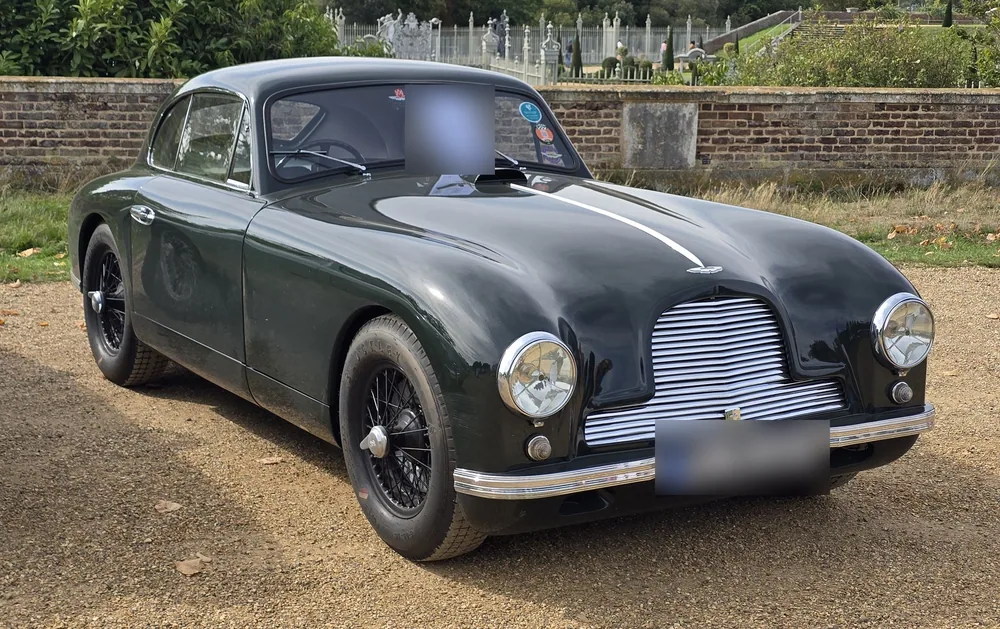
Yes, but never when it was new. The first car of the Brown years debuted at the 1948 London Motor Show as the 2-Litre Sports, with a 90 hp four-cylinder engine, and only 15 were sold.
People began calling it the DB1 once the DB2 arrived in 1950. Aston Martin itself now describes the name as retrospective. So the first car actually launched with the initials was the DB2, which Silodrome says debuted at the New York show in April 1950, with the Lagonda engine under its bonnet.
The DB2 is the car that fixed the formula, and more than 400 were sold by 1953. You can place it on the My Hangar Aston Martin timeline.
Which Aston Martins carried the DB name?
The main road-car line runs to thirteen names, from the 2-Litre Sports through to the DB12, with derivatives such as the DB4 GT and later cars such as the DBS Superleggera alongside them. The table gives the year each was introduced or first shown, which is why some dates sit a little earlier than the first deliveries.
| Model | Introduced | Worth knowing |
|---|---|---|
| DB1 (2-Litre Sports) | 1948 | Name applied later; 15 sold |
| DB2 | 1950 | First production Aston with the Lagonda six |
| DB2/4 | 1953 | Successor to the DB2; Mark II update in 1955 |
| DB Mark III | 1957 | Last of the DB2/4 line |
| DB4 | 1958 | 3.7 litres and Italian styling |
| DB5 | 1963 | The Goldfinger car |
| DB6 | 1965 | Larger and roomier than the DB4 and DB5 |
| DBS | 1967 | William Towns design; V8 version followed in 1969 |
| DB7 | 1993 | Shown at Geneva, unnamed; production from 1994 |
| DB9 | 2003 | First Aston Martin built at Gaydon |
| DB10 | 2015 | Bespoke car for the Bond film Spectre |
| DB11 | 2016 | Shown at Geneva in March; V12 and V8 |
| DB12 | 2023 | Replaced the DB11 in mid-2023 |
The initials also went on the racers. The DB3 and DB3S led to the DBR1, the car that won Le Mans in 1959. Launch years vary slightly between accounts, so where they differ we use the first public showing.
Why did the DB name disappear in 1972?
Because Brown sold the company. He had been knighted in 1968, and in 1972, for financial reasons, he parted with both Aston Martin Lagonda and his tractor division.
The buyer of Aston Martin was Company Developments, a Birmingham investment consortium. The DBS line ran out that year, and no new car carried the initials for more than two decades. Newport Pagnell, where the works had settled after Aston Martin bought coachbuilder Tickford in 1955, kept building the cars.
How did the DB name come back, and why is there no DB8?
It came back with permission. About 20 years after the sale, Walter Hayes, then running Aston Martin under Ford ownership, asked Sir David to let the initials return on a new car, known internally as NPX. Brown agreed.
The car appeared at the Geneva show in March 1993 without a name, and went into production as the DB7 in September 1994. Brown died in Monaco in 1993, aged 89, before the first production car was built. More than 7,000 DB7s followed, then the most-produced Aston Martin to that date.
The DB9 arrived in 2003 with no DB8 before it. Aston Martin's account is that the number was passed over because of how big a step the new car was. If you know your DB numbers, test them in the My Hangar Aston Martin quiz.
FAQ
What does DB stand for on an Aston Martin?
DB stands for David Brown, the British industrialist who owned Aston Martin from 1947 to 1972. Aston Martin used his initials on its road and racing cars during his ownership, and has used them again since the DB7.
Who was David Brown?
Sir David Brown (1904 to 1993) ran the Huddersfield gear firm his grandfather founded in 1860 and built David Brown tractors from 1939. He bought Aston Martin in 1947 and was knighted in 1968.
What was the first Aston Martin DB car?
The 2-Litre Sports of 1948 is now called the DB1, though that name came only after the DB2 appeared in 1950. The DB2 was the first to go on sale with the initials.
Why is there no Aston Martin DB8?
Aston Martin went straight from the DB7 to the DB9 in 2003. Its own history says the number was passed over because of the size of the advance the new car represented.
Sources
- Celebrating 70 years of the Aston Martin DB bloodline, Aston Martin
- Centenary feature: Sir David Brown, Aston Martin Magazine
- One hell of a company car, Motor Sport
- Aston Martin DB2, Silodrome
- Aston Martin, Wikipedia
- Aston Martin 2-Litre Sports, Wikipedia
- Aston Martin DB7, Wikipedia
- Aston Martin DB11, Wikipedia
Every figure here was checked against at least two independent sources, listed at the end.