Motorsport
Maserati 250F and Fangio: the 1957 title and the Nürburgring drive
Fangio won four 1957 championship races in a Maserati 250F. At the Nürburgring on 4 August he lost the lead in a 52-second pit stop, caught two Ferraris and won by 3.6 seconds to clinch his fifth title.
By the My Hangar editorsPublished 5 min read
Key takeaways
- Juan Manuel Fangio won the Argentine, Monaco, French and German Grands Prix of 1957 in a Maserati 250F.
- His win at the Nürburgring on 4 August 1957 clinched his fifth world title with two rounds still to run, and it was the 24th and last of his championship wins.
- A 52-second pit stop at the end of lap 12 dropped him about 50 seconds behind Mike Hawthorn and Peter Collins, with ten laps left.
- Fangio lowered his own pole time of 9min 25.6sec to a fastest lap of 9min 17.4sec and beat Hawthorn by 3.6 seconds.
- The 250F scored eight World Championship wins between 1954 and 1960, and 26 were built.
Juan Manuel Fangio won his fifth and final world title in a Maserati 250F in 1957, clinching it at the Nürburgring on 4 August. After a 52-second pit stop he rejoined about 50 seconds behind two Ferraris with ten laps left, lapped in 9min 17.4sec and won by 3.6 seconds. It was his 24th and last championship win.
What was the Maserati 250F?
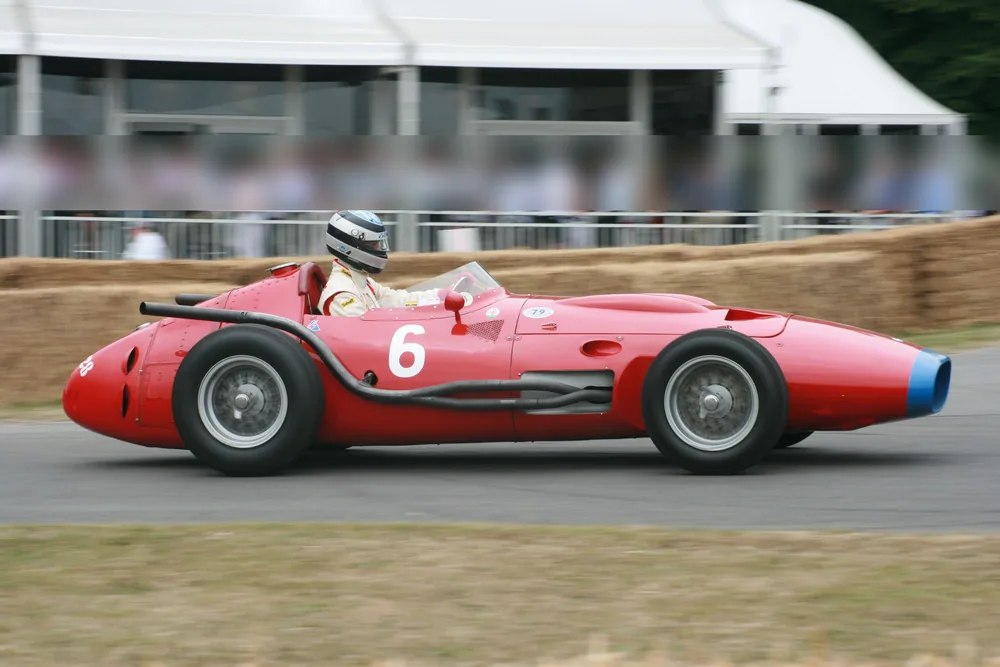
It was the front-engined Grand Prix car Maserati built for the 2.5-litre Formula One rules that began in 1954. Gioacchino Colombo, Bellentani and Alberto Massimino laid it out, and Valerio Colotti handled the tubular chassis work. A de Dion tube located the rear wheels.
Its engine was a 2,493 cc straight-six, with a bore and stroke of 84 by 75 mm. By 1957 it gave 270 bhp at 8,000 rpm. A V12 of 310 to 315 bhp also appeared that season, but it was the six that carried Fangio to the title.
Fangio won on the car's championship debut in Argentina in January 1954, and again in Belgium, before leaving for Mercedes-Benz that same season. Stirling Moss then won the 1956 Monaco and Italian Grands Prix in one.
| 250F fact | Figure |
|---|---|
| Years in Formula One | 1954–1960 |
| Cars built | 26 |
| World Championship wins | 8 |
| Winners | Fangio 6, Moss 2 |
| Engine | 2,493 cc straight-six |
| Output in 1957 | 270 bhp at 8,000 rpm |
How did Fangio win the 1957 title?
He returned to Maserati for 1957 and won four of the first six rounds. The Indianapolis 500 counted towards the championship at the time, which is why an American winner appears in the table.
| Round | Date | Winner |
|---|---|---|
| Argentina | 13 January | Fangio (Maserati) |
| Monaco | 19 May | Fangio (Maserati) |
| Indianapolis 500 | 30 May | Sam Hanks |
| France | 7 July | Fangio (Maserati) |
| Britain | 20 July | Moss |
| Germany | 4 August | Fangio (Maserati) |
| Pescara | 18 August | Moss |
| Italy | 8 September | Moss |
The German win took him to 34 points against 16 for Luigi Musso, his nearest rival, and settled the title with Pescara and Monza still to come. He was 46.
Why did Fangio need to catch up at the Nürburgring?
Because Maserati's plan was to stop and the Ferraris' was not. The soft Pirellis on the 250F wore quickly in practice, so Fangio would start with half a tank, build a lead and stop for fuel and rear tyres. Hawthorn and Collins, on harder Englebert tyres, would run through.
The plan worked for 12 of the 22 laps. He took pole in 9min 25.6sec, led from lap three and had a lead of 28 seconds when he came in. Then the stop went wrong: the mechanics had managed 30 seconds in practice, and Motor Sport timed this one at 52.
Accounts differ on why. Goodwood and Wikipedia describe a dropped wheel fixing, while Formula1.com mentions a loose seat that had to be tightened.
How did Fangio catch Hawthorn and Collins?
By taking corners a gear higher than he had ever dared, as he later told Autosport. For three laps the gap barely moved. Then it collapsed, helped by the fact that on a 14-mile lap the Ferrari pit could only signal its drivers once every nine minutes or so.
| Point in the race | Fangio's position |
|---|---|
| End of lap 12 | Stops with a 28 sec lead; 52 sec stationary |
| Rejoins | About 48–51 sec behind, by different accounts |
| Lap 16 | 33 sec behind |
| Lap 17 | 25.5 sec behind |
| Lap 19 | 13.5 sec behind after a 9min 23.4sec lap |
| End of lap 20 | 2 sec behind Hawthorn, after a 9min 17.4sec lap |
| Lap 21 | Passes Collins, then Hawthorn |
| Lap 22 | Wins by 3.6 sec in 3h 30min 38.3sec |
Motor Sport's report, written at the time, has him going inside Collins at the Nordkerve and passing Hawthorn before Breidscheid on the penultimate lap. His 9min 17.4sec was more than 24 seconds under his own 1956 record of 9min 41.6sec, and eight seconds under his pole time.
Hawthorn kept the pressure on to the flag, with Collins, whose clutch was failing, 35.6 seconds back in third.
Why is it called Fangio's greatest drive?
Because Fangio said so himself. Asked by Autosport to choose the race of his life, he picked this one. Formula1.com quotes him on the aftermath: "I made such demands on myself that I couldn't sleep for two nights afterwards."
It was also the end of something. He never won another championship race, and he decided to retire the following year. For Maserati, 1957 was a turning point too: Classic & Sports Car records it as the year the firm announced its withdrawal from racing as a factory team and launched the 3500 GT.
You can test what you remember in the My Hangar Maserati quiz, see where 1957 sits on the Maserati timeline, or go back to the start with the Maserati brothers in Bologna.
FAQ
How many races did Fangio win in the Maserati 250F in 1957?
Four World Championship rounds: Argentina, Monaco, France and Germany. With his two 1954 wins, that makes six of the 250F's eight championship victories.
How far behind was Fangio at the 1957 German Grand Prix?
About 50 seconds after his pit stop. Classic & Sports Car and Wikipedia give 48 seconds, while Fangio himself and Formula1.com give 51. Motor Sport's report at the time said more than three-quarters of a minute.
What was Fangio's fastest lap at the Nürburgring in 1957?
9min 17.4sec, around eight seconds faster than his pole position time of 9min 25.6sec.
Was the 1957 German Grand Prix Fangio's last win?
Yes. It was the 24th and last World Championship win of his career, and it clinched his fifth title.
Sources
- 1957 German Grand Prix race report (September 1957), Motor Sport
- F1's Best Drives #5: Fangio's race of a lifetime, Formula1.com
- Race of my life: Juan Manuel Fangio on the 1957 German GP, Autosport
- Fangio's 1957, part 6: German Grand Prix, Goodwood Road & Racing
- 110 years of Maserati, Classic & Sports Car
- Maserati 250F, Wikipedia
- The Maserati 250F, Supercars.net
- 1957 German Grand Prix, Wikipedia
- 1957 Formula One season, Wikipedia
Every figure here was checked against at least two independent sources, listed at the end.