People
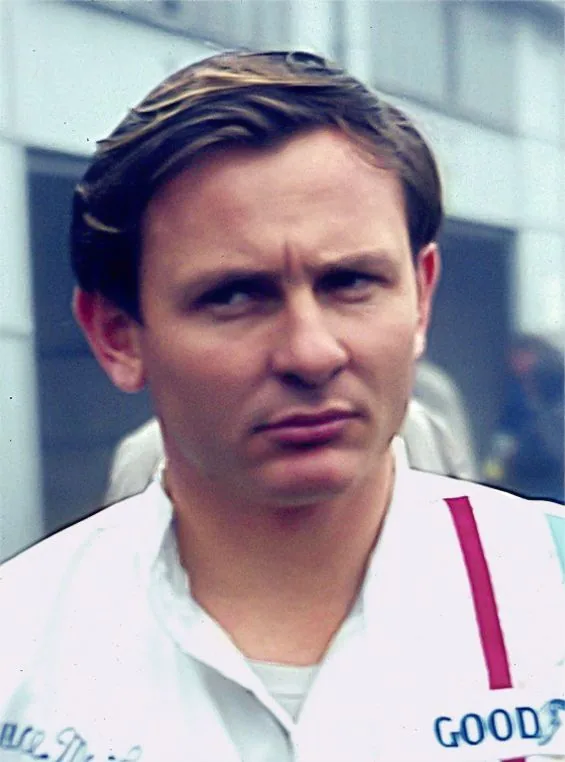
Bruce McLaren is born in Auckland
Bruce Leslie McLaren is born in New Zealand. At nine he is struck by Perthes disease, a hip condition that keeps him in treatment for years and leaves him with a permanent limp.
Woking Edition · Origins
Every model, the versions that mattered, the races that made the name and the people behind them. Scroll through the years, filter what you care about and open any moment for the details and sources.
158 moments · 55 model generations · 89 years
A childhood illness, a rebuilt Austin 7 and a scholarship carry a young New Zealander to Europe, where he becomes the youngest Grand Prix winner of his day.
1937
Bruce Leslie McLaren is born in New Zealand. At nine he is struck by Perthes disease, a hip condition that keeps him in treatment for years and leaves him with a permanent limp.
1952
At 14, Bruce starts competing in the Austin 7 Ulster he and his father have put back together. His first event is a hill climb at Muriwai, and he wins his class.
1958
New Zealand’s Grand Prix organisers pick Bruce as the first recipient of a scheme that sends a promising local driver to race abroad. It takes him to Europe and into Cooper’s orbit.
In a Formula 2 Cooper in a mixed field, Bruce finishes fifth overall on his first World Championship start, and first of the Formula 2 cars.
1959
Now a Cooper works driver, Bruce wins the United States Grand Prix at Sebring aged 22 years and 104 days. His record for the youngest winner lasts until the 2003 Hungarian Grand Prix.
1960
Bruce opens 1960 by winning in Buenos Aires for Cooper, and ends the year second in the championship to his team-mate Jack Brabham.
1962
With Brabham gone to start his own team, Bruce leads Cooper and wins the Monaco Grand Prix on his way to third in the championship.
Still driving for Cooper, Bruce McLaren starts a small company, builds sports cars, stumbles through two Grand Prix seasons and paints his Can-Am cars orange.
1963
While still driving for Cooper, Bruce sets up his own company. Around him are the Americans Teddy Mayer, a law graduate who had run a Formula Junior team, and Tyler Alexander.
1964
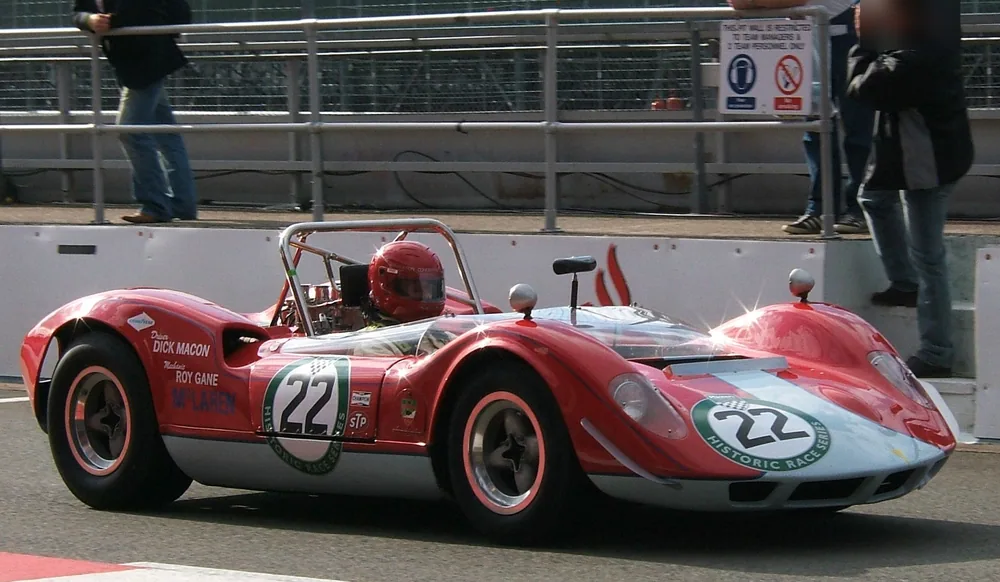
The team builds its own mid-engined sports-racer, a light spaceframe car. At Goodwood Bruce laps in 1m 21.6s, faster than the circuit record Graham Hill had set in a BRM Formula 1 car.
Teddy Mayer’s younger brother, Bruce’s team-mate in the Tasman Series, is killed in practice in Tasmania, days after his 26th birthday. It is the young team’s first great loss.
The new team’s first championship campaign, with Coopers built for the job, ends with Bruce winning the inaugural Tasman Series after a trio of wins in New Zealand.
Bruce buys Roger Penske’s ex-Formula 1 Cooper sports special and runs it with an Oldsmobile V8. At Aintree it beats Jim Clark’s Lotus 30 by 24 seconds, and wins follow at Silverstone, Mosport and Brands Hatch.
1965
After one or two cars built in-house, production of the sports-racer passes to Elva, part of the Trojan group, as the McLaren-Elva. The arrangement gives the small team a customer business.
Robin Herd, 26, leaves the Concorde project to design McLaren’s first single-seater. He chooses Mallite, balsa sandwiched between aluminium sheets: hugely stiff, but very hard to form into curves.
With Cooper’s form slipping, Bruce decides to build his own Formula 1 car for the new three-litre rules. He leaves at the end of the season after seven years.
1966
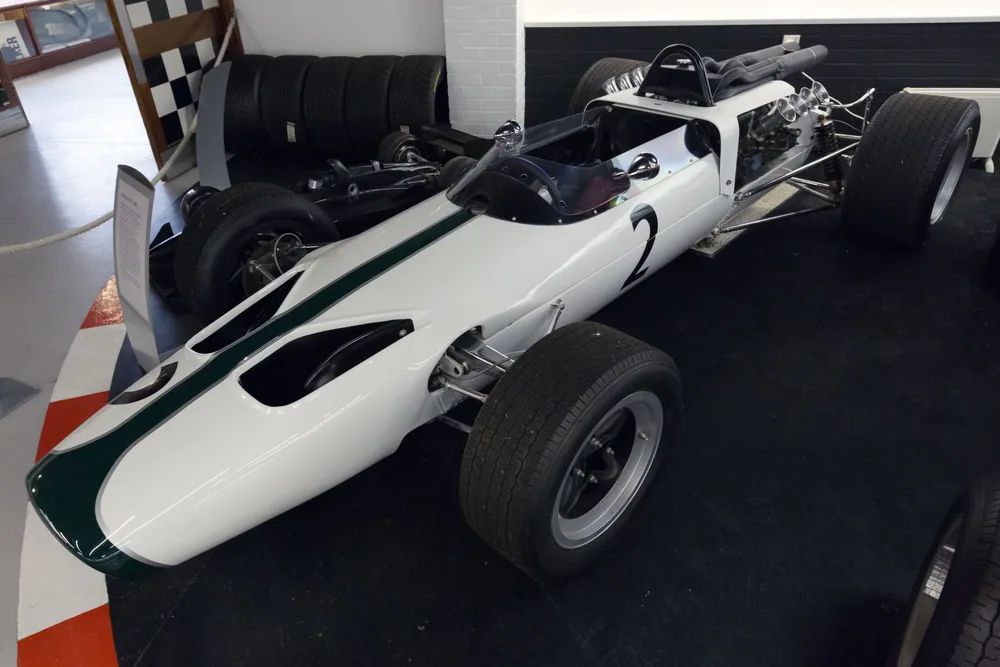
The M2B starts its first race with a reduced-capacity Ford Indy V8, large, heavy and short of power. Bruce retires after nine laps with an oil leak.
Disappointed by the Ford, Bruce takes an Italian Serenissima V8 to the Belgian Grand Prix. It fails in practice and, with no spare, he cannot start the race.
Bruce and Chris Amon win the 24 Hours in a seven-litre Ford Mk II. Ford’s planned dead heat with the sister car is refused, and the win goes to the pair who started further back and so covered more ground.
With the Serenissima engine, the M2B reaches the flag sixth in the British Grand Prix for the team’s first World Championship point. An entry for Amon goes unused because there is no car for him.
McLaren’s M1B meets the new Canadian-American Challenge Cup. John Surtees’ Lola takes the title, and midway through the year Bruce gives up his light Oldsmobile engine for a heavier, stronger Chevrolet.
1967
Designed in about 11 weeks by Herd, Don Beresford, Tyler Alexander and Bruce, the M6A is the team’s first monocoque sports car. After some 2,000 miles of testing at Goodwood it is painted a bright orange.
Bruce adds another major endurance win for Ford, sharing a Mk IV with Mario Andretti at the 12 Hours of Sebring.
While waiting for BRM’s V12, Bruce runs the M4B, a Formula 2 car with extra fuel tanks and a two-litre BRM V8. It takes fourth at Monaco, the team’s best result so far.
The M4B is written off in a fire during testing, and the V12 car is not ready. Bruce turns up at the French Grand Prix in Dan Gurney’s Eagle-Weslake and retires with ignition failure.
The team’s car for BRM’s new V12 makes its debut in a wet race in Canada. It reaches fourth, but a pit stop for a flat battery drops Bruce to seventh.
At Road America the two M6As are a second and a half clear in qualifying. Bruce’s engine goes after an oil leak, but Hulme wins, and then wins the next two rounds as well.
Five wins from six rounds, three for Hulme and two for Bruce. Both cars fail in the Las Vegas finale, which hands the race to Surtees and the championship to Bruce. The “Bruce and Denny Show” has begun.
Two New Zealanders win Grands Prix in their own cars and turn North America’s wildest series into a private contest, until a test day at Goodwood changes everything.
1968
Denny Hulme, 1967 champion with Brabham, moves across to race alongside Bruce in Formula 1. Phil Kerr follows him from Brabham to become joint managing director with Teddy Mayer.
Cosworth’s V8 is no longer exclusive to Lotus, and McLaren buys it. Herd starts the M7A and leaves for Cosworth before it is done, so Bruce and Gordon Coppuck finish a car that uses the engine as part of its structure.
Bruce starts looking at how to put a high-performance road car on sale. The result is the M6GT, a closed coupé from the Can-Am cars, but Group 4 rules demand 50 and McLaren cannot afford to build them.
The two new M7As appear at the non-championship «Race of Champions». Bruce wins from pole with fastest lap, and Hulme is third.
At the BRDC International Trophy, Hulme takes pole and the win with Bruce second. Chris Amon’s Ferrari is third, for an all-New Zealand podium.
Hulme finishes second to Graham Hill at Jarama, the M7A’s first championship race and the team’s first Grand Prix podium.
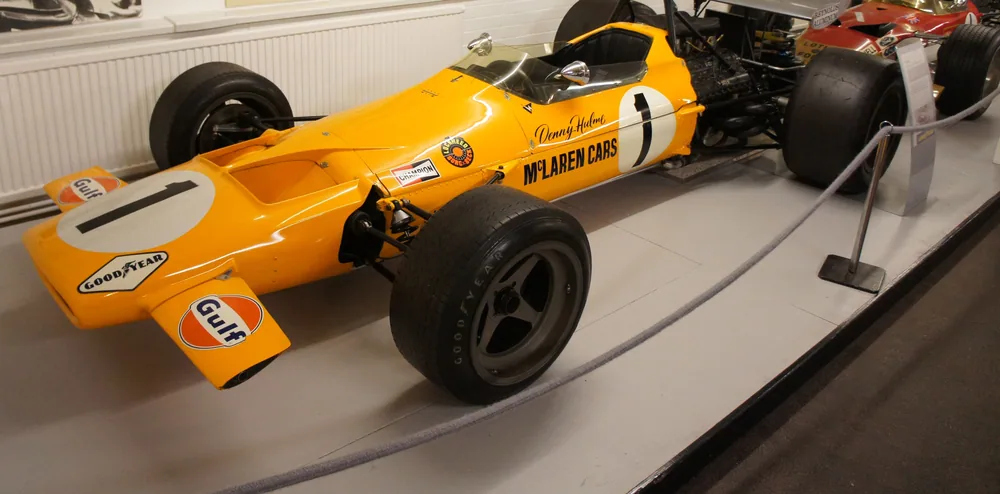
Bruce crosses the line at Spa believing he is second. Only when a BRM mechanic tells him does he learn that leader Jackie Stewart had stopped for fuel on the last lap. It is McLaren’s first Grand Prix win.
An all-aluminium seven-litre Chevrolet V8 now forms part of the structure. Hulme and Bruce finish first and second at Road America on the car’s debut.
Two weeks after winning at Monza, Hulme wins in Canada with Bruce second, the team’s first one-two in a Grand Prix. It draws Hulme level with Graham Hill at the top of the table.
A crash at Watkins Glen and retirement in Mexico end Hulme’s title hopes, though he finishes third overall. McLaren ends its third season second to Lotus, and Bruce is second in Mexico.
McLaren wins four of six rounds, three for Hulme and one for Bruce. Hulme’s victory at Las Vegas settles the title, by 35 points to 24.
1969
Coppuck turns the M7A into a Chevrolet-powered Formula 5000 car, which Trojan puts into production. Peter Gethin, in the prototype, wins Britain’s first Formula 5000 championship.
Jo Marquart’s four-wheel-drive car starts the British Grand Prix with Derek Bell driving and retires with rear suspension failure. There is no more time to develop it, and it never races again.
Better Goodyear tyres late in the year help Hulme win the last race of 1969 in a well-used M7A, McLaren’s only championship win that season. Bruce ends the year third in the standings.
The M8B, with its huge wing on pylons, wins every round of the 1969 Can-Am. Bruce takes six and Hulme five, and Bruce’s win in Texas ends the season with his second title.
1970
A straightforward evolution of the M7C brings second places for Hulme in South Africa and then Bruce in Spain. Jarama turns out to be Bruce’s last Grand Prix podium.
A filler cap works loose on the new M15 and methanol catches fire. Hulme suffers serious burns to his hands and has to withdraw from the race. Chris Amon, unsettled by the track, also pulls out.
The M15, drawn on Can-Am lines, runs with two replacement drivers. Peter Revson and Carl Williams are out of luck, though Williams finishes ninth.
Testing the new M8D, Bruce loses control on the Lavant Straight when the rear bodywork comes away at speed. The car hits a marshals’ post and he dies instantly, aged 32.
Teddy Mayer holds the team together. It keeps winning in Can-Am, conquers Indianapolis and, with Gordon Coppuck’s M23, finally has a Formula 1 car to match.
1970
Teddy Mayer sends the workforce home; they drift back the next morning anyway. Now leading the team, he tells them they have no boss, no driver and no car, but they do have a race at Mosport.
The team goes to the opening Can-Am round with Dan Gurney standing in, and he wins it, then wins again at St-Jovite. Sponsorship conflicts soon end his run in the car, and at 38 he also finds he has lost his spark in the Grand Prix seat he fills that summer.
Gurney’s replacement in the Can-Am team wins in the M8D, the one 1970 victory not taken by Gurney or Hulme. Mayer admits that he did far better than expected.
Back from his burns, Hulme wins six rounds and the championship. The M8D, nicknamed the “Batmobile” for its finned wing, loses only one race all year.
1971
Gordon Coppuck’s new Indy car, unveiled at Colnbrook, takes its wedge shape from the Lotus 72, with side radiators and a wing built into the engine cover. It helps start the era of huge wings at Indianapolis.
Ralph Bellamy’s new M19A leads the season opener with Hulme until the rear suspension fails close to the end. He limps home sixth, and the team wins nothing all year.
The M16 surprises the opposition in practice. Revson qualifies on pole at a record speed and finishes second to Al Unser, after Penske’s Mark Donohue, McLaren’s first Indy customer, breaks his gearbox.
Penske runs a McLaren M19A for Mark Donohue on his Formula 1 debut in Canada, and he finishes third. The deal costs Gethin his seat.
Taking Gethin’s place in the big-block M8F, Revson wins five rounds and Hulme three, for McLaren’s fifth title in a row.
1972
The cosmetics company, previously with BRM, becomes McLaren’s first title sponsor. The Grand Prix cars turn mostly white and the team races as Yardley Team McLaren.
The M22 Formula 5000 car is the last from the partnership. After 1972, McLaren and Trojan, its customer-car builder since the mid-1960s, go their separate ways.
A year after the suspension failure, Hulme wins the South African Grand Prix, McLaren’s first championship win since Mexico 1969. The team ends the year third in the table.
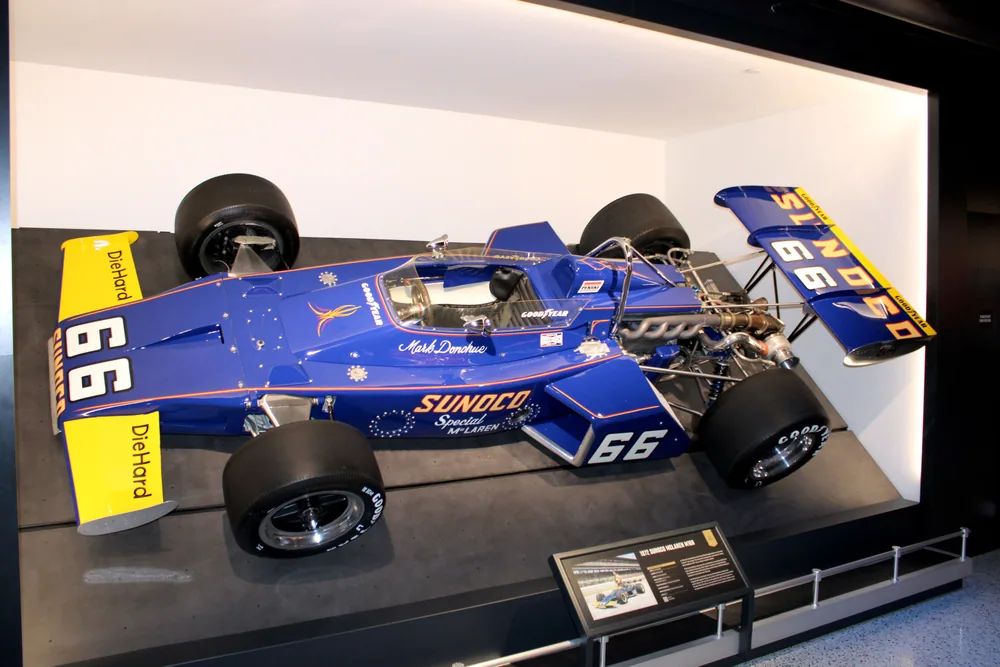
Nursing his engine through a race of attrition, Mark Donohue leads only the final 13 laps in Penske’s M16B and wins $218,000. It is the first Indianapolis 500 win for both McLaren and Penske.
Less than two years after arriving in Britain to race Formula Ford, Jody Scheckter is given a works M19A for the United States Grand Prix.
The M20 wins twice with Hulme, but the turbocharged Porsche 917/10 is too strong and George Follmer takes the title. McLaren leaves Can-Am to focus elsewhere.
1973
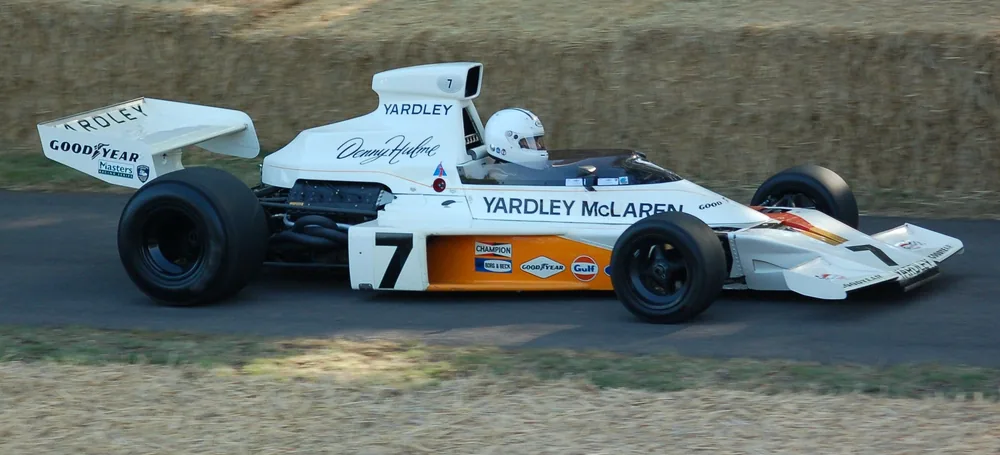
Coppuck’s new car, built on lessons from the M16 Indy car, has its first race in South Africa, the third round of 1973. Hulme puts it on pole, the only one of his career.
Hulme wins the Swedish Grand Prix at Anderstorp, seven races into the season, the first of 16 Grand Prix wins for the type.
Running wide out of Woodcote at the end of lap one, Scheckter spins his M23 back across the track. The pile-up stops the race and takes out about nine cars.
After the restart, Revson wins the British Grand Prix by 2.8 seconds from Ronnie Peterson, his first victory at this level.
A second win at Mosport makes it two for the heir to the Revlon family, both of them in the M23. They are the only Grands Prix he ever wins. McLaren finishes third among constructors.
Philip Morris tells the 1972 champion that he can choose his team. He picks McLaren over Brabham and Tyrrell, and starts testing at Paul Ricard in December. Texaco also joins, in a red-and-white superteam.
Marlboro, Texaco and Emerson Fittipaldi arrive together and bring McLaren its first world titles, before the Brazilian springs a surprise of his own.
1974
Three M23s line up in Buenos Aires, two in red and white and one in Yardley colours. Hulme passes Carlos Reutemann’s ailing Brabham two laps from the end for the last of his eight Grand Prix wins.
After a delay of his own making in Argentina, Fittipaldi wins from pole at Interlagos in only his second race for the team, 13 seconds clear of Clay Regazzoni.
Now at Shadow, the former McLaren driver dies in a test before the South African Grand Prix when a front suspension failure sends him into the barrier.
Johnny Rutherford scores the works team’s first Indianapolis 500 win in the M16 from 25th on the grid, still in papaya orange. A week later he wins again at Milwaukee.
The motorcycling great crashes the Yardley M23 heavily after landing badly on a jump and injures his legs. He never races a car again. David Hobbs, and then Jochen Mass, take over the car.
After a new rear suspension from Coppuck transforms the car, a second place at Monza and a win at Mosport bring Fittipaldi level with Regazzoni on 52 points.
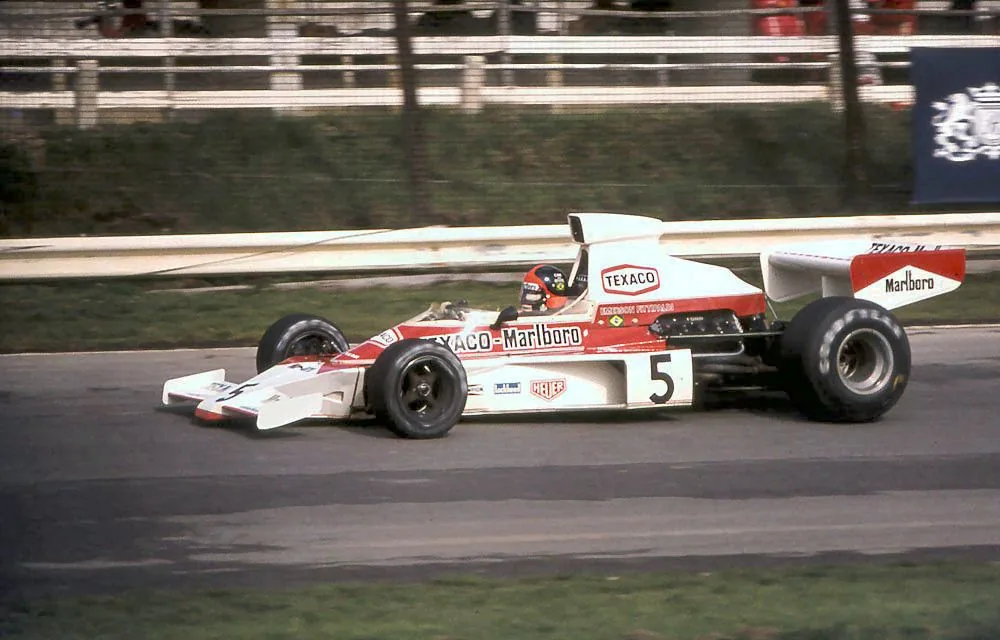
At Watkins Glen, fourth place is enough. Regazzoni’s Ferrari suffers a failed damper, and Fittipaldi wins his second drivers’ title and McLaren its first drivers’ and constructors’ championships.
1975
Emerson announces he will leave for 1976 to join his brother Wilson’s Copersucar-backed team. With little time left, McLaren and Marlboro turn to James Hunt.
Beaten by Ferrari’s 312T, Fittipaldi finishes second to Niki Lauda in the drivers’ table and McLaren drops to third among constructors.
At Montjuïc, promoted to the main team, Jochen Mass wins his only Grand Prix. It is stopped after 29 of 75 laps when Rolf Stommelen’s Hill goes over the barrier, killing four onlookers.
The new M16E, largely the work of Coppuck’s young assistant John Barnard, takes Rutherford to second at Indianapolis in a race cut short by a downpour with Bobby Unser ahead.
A hailstorm sends several front-runners off at the same corner at Silverstone. Fittipaldi, who stays out of trouble, is declared the winner. He never wins a Grand Prix again.
James Hunt wins the 1976 world title in the last race of an extraordinary season. Within three years the team has lost its edge, and its main sponsor starts looking for someone else to run it.
1976
Fittipaldi’s sudden exit gave Hunt the seat at McLaren. At Jarama he won, then lost the result when his car was ruled too wide. McLaren appealed and the win was restored. In Britain he would be disqualified again, and that one stood.
The car meant to replace the long-serving M23 first raced at the 1976 Dutch Grand Prix. It took time to displace the older car, and drivers did not find it as friendly.
Hunt arrived at the first Japanese Grand Prix chasing Niki Lauda, back at the wheel weeks after his burns at the Nürburgring. In torrential rain Lauda pulled in after two laps. Hunt’s third place was enough for the title by a single point.
1977
McLaren entered an extra M23 at Silverstone for a young Canadian warmly recommended by Hunt, who had come across him at a Formula Atlantic race in 1976. It was a one-off, and Hunt won the Grand Prix.
At Fuji Hunt took the tenth and last Grand Prix win of his career. McLaren would not win another until John Watson at Silverstone in July 1981.
1978
McLaren dropped Hunt for 1979 and signed Ronnie Peterson of Lotus. Peterson died after a crash at the Italian Grand Prix, and the seat went to John Watson. Hunt left for Wolf and retired within a few races.
1979
The M28 appeared in Argentina in January 1979. Teddy Mayer’s verdict was brutal, and by the British Grand Prix in July McLaren had already rolled out a lighter, more compact replacement, the M29.
1980
Teddy Mayer had been so struck by Prost’s test at Paul Ricard that he reportedly ran to fetch a contract. The Frenchman debuted in Buenos Aires in a difficult car, and left for Renault after one season.
Ron Dennis and John Barnard arrive with a chassis idea nobody in Formula 1 has tried. Add Niki Lauda, Alain Prost and a Porsche-built turbo paid for by TAG, and McLaren wins three drivers’ titles in a row.
1980
After results collapsed, sponsor Philip Morris pressed Teddy Mayer to merge with Dennis’s Formula 2 outfit, also Marlboro-backed. Effectively a reverse takeover, it created McLaren International and brought designer John Barnard to the team.
1981
Barnard’s car arrived at the third round in Argentina, a single example for John Watson. Rival teams struggled to copy it that year. MP4 stood for Marlboro Project Four.
The first victory for the MP4, and McLaren’s first since 1977, came in front of a home crowd. McLaren later called that afternoon the point where the upturn began.
1982
Dennis talked the double champion back after two years away, with a clause letting McLaren walk away if he was not competitive. In South Africa Lauda helped lead a drivers’ strike over the superlicence. In his third race back, at Long Beach, he won.
1983
Prost lost the 1983 title at the last race, criticised Renault publicly and was fired. Dennis was waiting with a contract, and Prost took Watson’s seat alongside Lauda.
Tyre troubles left Watson and Lauda almost last in qualifying. On race day both charged through the field, and Watson won from Lauda. A year earlier Watson had also won in Detroit from 17th on the grid.
Dennis persuaded Mansour Ojjeh of TAG to pay Porsche to build a turbo to Barnard’s specification. It first ran at Zandvoort in Lauda’s interim MP4/1E, while Watson stayed with the old Cosworth for that weekend.
1984
McLaren won 12 of 16 races with the MP4/2. Prost won seven to Lauda’s five, including the Portuguese finale, but Lauda’s second place at Estoril gave him his third title by the narrowest margin in the championship’s history.
1985
Fourth at Brands Hatch was enough, with two races left, and McLaren took the constructors’ title too. It was a miserable last year for Lauda, who announced his retirement in Austria and won only once more, at Zandvoort, holding off Prost.
1986
His relationship with Dennis had broken down. Barnard agreed terms in Modena on condition he could design the car from an office in Guildford, not Maranello. He sold his McLaren shares at the end of the year, and Gordon Murray became technical director.
Williams had the faster car and Mansell only needed third. Then Mansell’s tyre blew, Piquet was called in for a precautionary stop, and Prost won the race and the title, the first driver to retain the crown since Jack Brabham in 1960.
1987
Honda announced it would leave Williams and supply McLaren. Moments later Dennis drove away from the circuit in a convertible with Prost and Senna as passengers, a staged picture of his 1988 line-up. Porsche had ended the TAG adventure days before.
In a year when the TAG engine was running out of development, one of Prost’s three wins made him the most successful Grand Prix driver in history at that point.
Two of the greatest drivers ever share one team and a Honda engine. They win almost everything, then turn on each other, while Gordon Murray begins sketching a road car.
1988
Murray had dreamed of a central driving position since his youth. He drew the idea while waiting for a flight home from the Italian Grand Prix and took it to Dennis. It became McLaren’s first purpose-built road car, and Murray’s first road-car design.
Rule changes were meant to hobble turbos in their final year, and many expected a transitional season. Prost reportedly told Dennis after a few laps that it would win the title. It won first time out in Brazil, where Senna was disqualified.
McLaren’s only defeat of 1988 came when Senna, leading, collided with Jean-Louis Schlesser at the first chicane. Schlesser, aged 40, was only there because Mansell was ill and making his debut for Williams.
Prost scored more points over the year, but only the best 11 results counted. Senna’s eighth win of the season, at the penultimate race, settled it. McLaren’s 199 constructors’ points were almost three times Ferrari’s tally.
1989
Their pact had ended at Imola in April, when Prost said Senna broke a no-passing deal, and they barely spoke afterwards. At the Casio chicane the McLarens tangled. Senna rejoined and won, was then disqualified, and Prost, already bound for Ferrari, was champion.
1990
Prost, now in a Ferrari, was Senna’s last rival. Senna hit him at the first corner and both were out at once, which made Senna champion for the second time and gave McLaren a third straight constructors’ title.
1991
It was his eighth attempt at his home race. With his gearbox failing he nursed the MP4/6 home in the rain at Interlagos, and was lifted from the car suffering severe cramps.
Williams-Renault had the pace by mid-season, but McLaren’s early wins and Honda’s relentless V12 development held them off. At Suzuka Senna clinched it, then handed the race win to Gerhard Berger.
1992
On the Thursday of the Grand Prix, Senna was among the guests at the Sporting d’Été as Murray’s BMW V12 supercar was shown. It used a carbon-fibre monocoque, a first for a production car, and even gold among its materials.
On the eve of practice at Monza, Honda’s president Nobuhiko Kawamoto said the company would stop at the end of the season after a decade in the sport. McLaren, after five wins and no title in 1992, was suddenly adrift.
Honda leaves, Senna follows and the Grand Prix wins stop for more than three years. A road car wins Le Mans at its first attempt, and a new deal with Mercedes slowly starts to pay.
1993
With a customer Ford V8 and a contract he had agreed only race by race, Senna went from fifth to first on the opening lap of a wet European Grand Prix and went on to win. McLaren itself ranks it among his greatest drives.
McLaren and Michael Andretti split on 16 September, and test driver Mika Häkkinen got the seat. At Estoril the young Finn immediately went quicker than Senna in qualifying, then made the podium in his second race.
In his last race for McLaren, before moving to Williams, Senna won in Australia. It was the 41st and last win of his career, and took McLaren past Ferrari’s record for Grand Prix victories. The team would not win again until 1997.
1994
McLaren tried a Lamborghini V12 before choosing a works Peugeot V10. Häkkinen and Martin Brundle scored eight podiums but no wins and suffered 17 retirements, and the deal lasted a single season.
1995
Mercedes came as McLaren’s works engine partner in a deal that would run for 18 seasons and bring 78 wins. It started awkwardly: Nigel Mansell, signed at Mercedes’ urging, did not fit the MP4/10 and missed the opening races, then quit after two starts.
Built from a road car and never planned as a racer, the McLaren beat purpose-built prototypes in one of the wettest Le Mans on record. JJ Lehto, Yannick Dalmas and Masanori Sekiya shared the winning car.
A huge crash in Friday practice left him unable to breathe. A doctor performed an emergency tracheotomy beside the circuit. Ron Dennis and his wife stayed at his bedside for days, and Häkkinen went on to race again.
1997
David Coulthard won the season opener, McLaren’s first win since Senna’s farewell in 1993. McLaren’s 105th victory also came in new colours: Marlboro, on the cars since 1974, had moved to Ferrari, and West brought the silver livery.
Contractual restrictions kept him from working on McLaren’s car until August. He then had a full run at the new narrow-track, grooved-tyre rules of 1998, and McLaren’s Neil Oatley admitted the team had not expected to be so competitive.
The victory came at the last race of 1997, at the European Grand Prix. He said it gave him the confidence of being a winner all winter. Nineteen more wins and two titles followed in the next four seasons.
Adrian Newey’s cars bring Mika Häkkinen two titles. A decade of near misses follows, ending in the biggest scandal the team has known and Lewis Hamilton’s title on the last corner of 2008.
1998
At Ehra-Lessien in Germany, Le Mans winner Andy Wallace drove the XP5 prototype, with its rev limiter raised, to a two-way average of 240.1 mph.
After Ferrari got the team’s brake-steer system banned at the second race, McLaren fought Schumacher to the last round. Häkkinen won at Suzuka to reach exactly 100 points. It was the first double with Mercedes-Benz and West.
1999
He arrived four points behind Eddie Irvine and beat Schumacher and Irvine in the last race. Ferrari still took the constructors’ title by four points, after a season in which the complex MP4-14 took a long time to come good.
2001
The team’s workforce was shocked when the double champion decided to retire at the end of 2001. His replacement for 2002 was a young Finn, Kimi Räikkönen.
2003
Newey’s radical design failed crash tests and suffered cooling problems. McLaren carried on with an updated MP4-17D, and Räikkönen still lost the title by only two points. The team later said the lessons shaped the 2008 car.
Mercedes then owned 40 percent of the McLaren Group, and the two built a front-mid-engined grand tourer together. Its carbon-fibre structure was produced at a new plant in Woking, under McLaren’s management.
2005
McLaren’s most successful year in a long time: ten wins for the MP4-20, shared by Räikkönen and Juan Pablo Montoya. The car’s poor reliability and early tyre problems still handed both titles to Fernando Alonso and Renault.
2007
After podiums in his first five races he won in Canada from pole, then again a week later at Indianapolis, beating team-mate and reigning champion Alonso. He lost the title to Räikkönen by a single point.
Confidential Ferrari technical information had reached a senior McLaren engineer. A second FIA hearing excluded the team from the 2007 constructors’ standings and fined it a record $100 million, though the drivers kept their points.
2008
Felipe Massa won at Interlagos. Hamilton needed fifth and got it at the final corner in the wet. It was McLaren’s first drivers’ title since 1999, and Ferrari took the constructors’ crown.
2009
After the damage of 2007, Dennis stepped down as team principal, handing over to his long-time colleague just before the season, and moved his attention to McLaren’s road car plans.
McLaren becomes a real car maker with the 12C and the P1. On track the wins dry up, the reunion with Honda fails, and in 2016 the man who built the modern company is forced out.
2010
Mercedes returned as a constructor in its own right and began selling its 40 percent of McLaren, which became a customer. McLaren signed champion Jenson Button to race alongside Hamilton.
2011
McLaren’s first production car since the F1 ended in 1998 came from the new McLaren Automotive, set up in 2010 as a standalone maker. It was shown online in 2009, and Car and Driver called it Ferrari’s worst nightmare.
2013
Shown as a concept in Paris on the F1’s 20th anniversary, the P1 made its Geneva debut in 2013 and joined the race with the Porsche 918 and the LaFerrari. Designer Frank Stephenson took ideas from a sailfish he saw on holiday in Miami. Just 375 were built.
2014
After 2013, the first season without a podium since 1980, Whitmarsh lost his post and Dennis returned as chief executive. The decision to use Honda engines from 2015 had already been taken.
2015
McLaren organised its cars into Sports, Super and Ultimate Series, with the 570S and 540C at the entry point. Their carbon tub had sills lower by 80 mm to make them easier to live with every day.
Alonso missed the opener after a heavy testing crash, and Button finished last of the runners in Melbourne, two laps down. Cars ran so hot that mechanics threw wet towels on the sidepods. McLaren ended 2015 ninth, its worst result since 1980.
2016
After a long dispute with his fellow shareholders Dennis lost his chairman and chief executive roles, though he kept his shares. Days later American marketing man Zak Brown joined as executive director.
Honda goes, Renault comes and the team climbs from the back of the midfield. A win at Monza in 2021 and a transformed car in Austria in 2023 show the way back to the front.
2017
A new Super Series car, on a MonoCage II tub with a 4.0-litre twin-turbo V8, stayed in production until December 2022. Its successor, the 750S, was built on the same base.
At Singapore the two announced the end of the deal, and McLaren took Renault engines for the first time in its history, on a three-year customer contract. The team finished the Honda years ninth, sixth and ninth without a podium.
Unveiled online in December and shown at Geneva in 2018, the Senna put track performance first. Evo reported that all 500 had already been allocated. McLaren’s use of the name honoured the driver of its first Honda titles.
2018
This hybrid with a planned run of 106 could carry its driver and two friends to a claimed 403 km/h, with cameras in place of door mirrors. Number 106 echoed the total of the F1 family.
2019
Fourth on the road, Sainz was promoted to third after a penalty for Lewis Hamilton, too late for the ceremony, so the team held its own improvised celebration at an empty Interlagos. It was McLaren’s first podium since 2014, and it finished fourth overall.
2021
Back on Mercedes power, McLaren won for the first time since Brazil 2012, with Lando Norris second. It was the team’s first one-two since the 2010 Canadian Grand Prix, and Ricciardo’s last Formula 1 win.
2022
McLaren’s third hybrid and its first with a V6: a new 3.0-litre twin-turbo engine and one electric motor on a new carbon architecture called MCLA. The name combines “art” and “future”.
2023
New team principal Andrea Stella had said all along that the launch MCL60 was a placeholder. With 17 points from eight rounds, the first parts went on Norris’s car at the Red Bull Ring and he finished fourth. McLaren took nine podiums in what remained of the year.
Norris’s stop on lap 28 was a Formula 1 record, taking 0.02 seconds off Red Bull’s previous best. On the same night McLaren reached 500 podiums in the championship.
McLaren wins its first constructors’ title since 1998, defends it, and gives Lando Norris the drivers’ crown. Meanwhile the road car business changes hands and the team starts its 1,000th Grand Prix.
2024
A first big upgrade of the MCL38, and a well-timed Safety Car, gave Norris his first Grand Prix win at the 110th time of asking. From there McLaren could contest victories at any race.
The successor to the P1 pairs a new V8 with a hybrid system for a total of 1,275 PS. McLaren limited it to 399 cars at £2 million or more each, all of them sold.
Norris won the Abu Dhabi finale to seal it, 14 points clear of Ferrari. The MCL38 scored at every event and went the whole year without a mechanical failure in a Grand Prix or Sprint.
2025
Abu Dhabi’s CYVN Holdings completed its takeover of McLaren Automotive, with a minority stake in the racing team, and merged it with its British start-up Forseven. The plan: expand beyond mid-engined supercars for the first time.
Mumtalakat and CYVN bought the remaining shares from investors including MSP Sports Capital, in a deal reported to value the reigning champions at around $5 billion. Mumtalakat stayed the majority owner.
McLaren sealed its second title in a row in Singapore, with the MCL39 on its way to 14 wins from 24 races. McLaren had not won two constructors’ titles in a row since 1991.
Three drivers arrived in Abu Dhabi with a chance. Max Verstappen won, Piastri was second and Norris’s third place gave him the title, 423 points to 421. It was McLaren’s first drivers’ title since Hamilton in 2008, and its first double since 1998.
2026
McLaren fully revealed its Hypercar for the 2027 World Endurance Championship, more than 30 years after the F1 GTR’s win. It first appeared as a show car at Le Mans in 2025 and took its testing livery from the M6A.
The team chose the race where it debuted in 1966 for a special livery. In the strict count it was start 999: both MCL40s had failed to take the start in China in March with power unit trouble. Piastri finished fourth at Monaco and Norris retired.
Production years of each road-car generation. Tap a bar to see its notable versions.
Sports-racers & Can-Am
Grand Prix cars
Indy cars
Formula 2 & Formula 5000
F1 road car
Le Mans cars
SLR
Super Series
Sports Series
GT
Ultimate Series
Today’s daily has ten questions on these cars. Same for everyone, two minutes.