Motorsport
Porsche 917 history: the car that gave Porsche its first Le Mans wins
The Porsche 917 was a flat-12 sports racer homologated with 25 cars in April 1969. It won Le Mans in 1970 and 1971, set a distance record that lasted until 2010, then dominated Can-Am with turbos.
By the My Hangar editorsPublished 6 min read
Key takeaways
- Porsche presented the 25 cars needed to homologate the 917 to the sporting authorities on 21 April 1969.
- The 917 K won Le Mans in 1970 with Hans Herrmann and Richard Attwood and in 1971 with Helmut Marko and Gijs van Lennep.
- The 1971 winner covered 5,335 km at an average of 222.3 km/h, a Le Mans distance record that stood until 2010.
- The air-cooled flat-12 grew from 4.5 litres in 1969 to 5.0 litres and 630 PS in 1971.
- The turbocharged 917/30 Can-Am car had 5.4 litres and 1,100 PS by Porsche's figure, and won the 1973 Can-Am title with Mark Donohue.
The Porsche 917 is the car that gave Porsche its first overall Le Mans wins, in 1970 and 1971. Built around an air-cooled flat-12 of 4.5 litres, it was homologated when Porsche lined up 25 finished cars for inspectors on 21 April 1969. In 1971 it set a Le Mans distance record of 5,335 km that lasted 39 years, and its turbocharged Can-Am versions later made over 1,000 PS.
Why did Porsche build 25 cars of the 917?
Because the rules demanded it. For 1969 the sporting authorities cut the minimum production for 5-litre sports cars from 50 to 25 units, and Porsche decided to build a car for that class alongside its 3-litre 908 prototypes.
Design work started in June 1968, before the project had official approval, and the first engine ran on the test bench in early December 1968. The 917 was shown at the Geneva Motor Show in March 1969. On 21 April 1969 the 25 cars needed for homologation were lined up in the car park of Porsche's Plant 1 in Zuffenhausen for inspection, less than a year after work began.
Each customer car cost 140,000 marks, with the removable long tail included. The chassis was an aluminium tubular space frame weighing about 45 kg, and the complete car weighed around 800 kg.
How powerful was the Porsche 917 engine?
The 917 used Porsche's first twelve-cylinder engine, an air-cooled 180-degree flat-12 designed by Hans Mezger's team. Output depends on year and on who is quoting.
| Version | Year | Displacement | Output | Basis |
|---|---|---|---|---|
| 917 (original) | 1969 | 4.5 litres | 520–580 PS | 520 PS claimed in 1969; Porsche now quotes 580 PS |
| 917 K | 1970 | 4.9 litres | about 600 PS | period and press figures |
| 917 K | 1971 | 5.0 litres (4,999 cc) | 630 PS | Porsche Museum figure |
| 917/10 Can-Am | 1972 | 5.0 litres, turbo | over 1,000 PS | Porsche: turbo engines on the Weissach test bench, spring 1972 |
| 917/30 Can-Am | 1973 | 5.4 litres (5,374 cc), twin-turbo | 1,100 PS | Porsche Museum datasheet; Porsche also cites over 1,200 PS in final form |
The 1969 figure is the main point of disagreement. Motor Sport reported Porsche's claim of 520 bhp at the time; Porsche's own later histories and the ACO quote 580 PS. The 1970 Le Mans winner deliberately ran the smaller 4.5-litre engine rather than the 4.9 for reliability, according to Richard Attwood's own accounts.
How did the 917 win Le Mans in 1970 and 1971?
At first, it did not. On its Le Mans debut in 1969 Rolf Stommelen put a 917 on pole and the cars led for long periods, but no 917 finished. Early cars were unstable at speed, and the reworked short-tail 917 K body made the car far more stable for 1970.
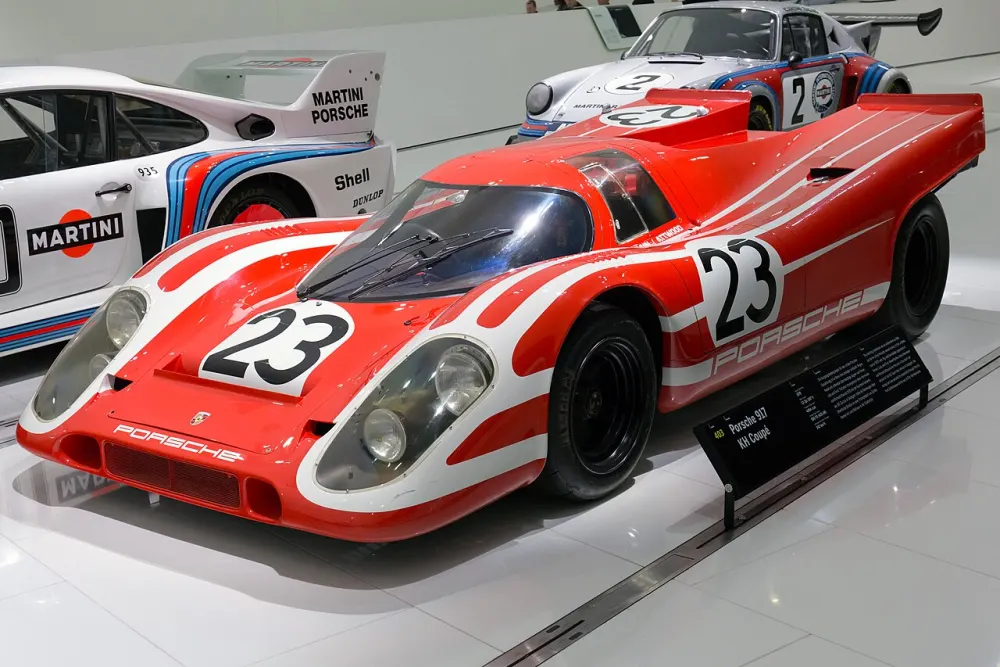
In 1970 Hans Herrmann and Richard Attwood won in the red-and-white No. 23 917 K entered by Porsche KG Salzburg, covering 343 laps in rain-soaked conditions. A Martini-entered 917 LH finished second. That season the 917 and the 908/03 won nine of the ten World Championship rounds, and Porsche took the makes title.
In 1971 the white Martini 917 K of Helmut Marko and Gijs van Lennep won after 397 laps, 5,335 km at an average of 222.3 km/h. That distance stood as the Le Mans record until 2010. The winning car used an experimental magnesium frame, lighter than the usual aluminium. It was the 917's last Le Mans as a works-backed contender: from 1972 the world championship limited engines to 3 litres, which ruled out the 5-litre cars. See where both wins sit among Porsche's 19 in our complete list of Porsche Le Mans wins.
917 K versus 917 LH
The K (Kurzheck, short tail) was more stable and won both races. The LH (Langheck, long tail) was more slippery and faster on the Mulsanne Straight.
Which liveries made the 917 famous?
Three teams and their colours defined the car's image. They were not the same team, which is why the 917 appears in so many paint schemes.
- Gulf: light blue and orange cars run by John Wyer's JW Automotive Engineering (JWA), the team most associated with the 917 in 1970–71. A Gulf 917 K, No. 20, is the car Steve McQueen drives in the 1971 film Le Mans.
- Salzburg: red and white, entered by Porsche KG Salzburg, the family's Austrian company. Its No. 23 car won Le Mans in 1970.
- Martini: the Martini team entered the purple-and-green "psychedelic" 917 LH (No. 3) that finished second in 1970, nicknamed the "Hippie", and the white No. 22 car that won in 1971.
One more is worth knowing: the one-off 917/20 "Pink Pig" of 1971, a wide-bodied car painted pink and marked like butcher's cuts by designer Anatole Lapine. It raced only once, at Le Mans 1971, and retired after an accident.
What did the 917 do in Can-Am?
It won the Can-Am title in 1972 and 1973. Shut out of the world championship after 1971, the 917 moved to the near-unlimited Can-Am series as an open spyder, and the flat-12 became the first Porsche engine raced with turbocharging.
- 1972: the turbocharged 917/10 won the championship with George Follmer of the Penske team, after Mark Donohue was injured in testing.
- 1973: the longer 917/30, with a 5.4-litre twin-turbo engine, carried Mark Donohue and Penske to the title, winning six races. For 1974 the organisers brought in a fuel-consumption limit, and 1973 was Porsche's last season as a Can-Am force.
On 9 August 1975 Donohue drove a 917/30 around the Talladega oval at an average of 221.120 mph (355.86 km/h), a closed-course speed record. For the record run, Porsche says, the engine had been turned up to 1,230 PS.
Porsche's turbocharged racers that followed, up to the 956, built on this experience; see our article on the Porsche 956 and 962 in Group C. The 917 also appears in the daily Porsche quiz and on the Porsche timeline.
FAQ
How many Porsche 917s were built?
Porsche built 25 cars for homologation by April 1969, the minimum the rules required. More chassis followed in later variants, so the total is higher; counts differ by source and by what is counted as a new chassis.
How many times did the Porsche 917 win Le Mans?
Twice: in 1970 with Hans Herrmann and Richard Attwood, and in 1971 with Helmut Marko and Gijs van Lennep. Both wins came with the short-tail 917 K.
How fast was the Porsche 917?
The 1971 winner averaged 222.3 km/h over 24 hours. The Can-Am 917/30 averaged 355.86 km/h around Talladega in 1975, a closed-course record at the time.
Why is the Gulf Porsche 917 so famous?
JW Automotive's Gulf-liveried 917 Ks were among the most successful 917s of 1970–71, and a Gulf 917 starred in Steve McQueen's 1971 film Le Mans. The Gulf cars did not, however, win Le Mans.
What does 917 K mean?
K stands for Kurzheck, German for short tail. The long-tail Le Mans version is the 917 LH, for Langheck.
Sources
- The first 917: witnesses from Weissach, Porsche Newsroom
- Why is the Porsche 917 such a motorsport icon?, 24h-lemans.com
- 75 years of Porsche sports car motorsport, Porsche Newsroom
- Weissach and the 917, Christophorus (Porsche)
- Porsche 917/30 Spyder datasheet, Porsche Museum
- Racing car: Porsche 917, Motor Sport Magazine archive
- Le Mans 24 Hours 1971 results, Racing Sports Cars
- Porsche 917, Wikipedia
Every figure here was checked against at least two independent sources, listed at the end.