History
The Aston Martin DB5 and James Bond: the real history of the car
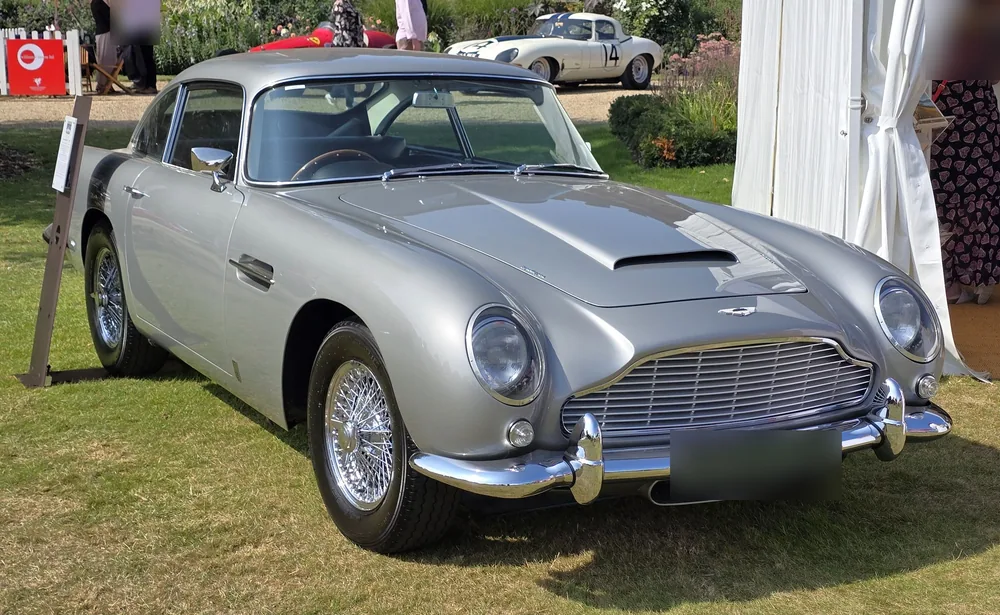
The Goldfinger DB5 began as a red prototype, chassis DP/216/1, resprayed Silver Birch and fitted with gadgets for the 1964 film. Four Goldfinger-specification cars were made, and the original was stolen in 1997.
By the My Hangar editorsPublished 6 min read
Key takeaways
- The first Goldfinger DB5 was the development prototype, chassis DP/216/1, registered BMT 216A and first finished in Dubonnet Red.
- David Brown wanted the film company to buy the cars; the compromise was a loan for the length of filming.
- Four Goldfinger-specification DB5s were built: two for filming and two for promotion.
- Chassis DP/216/1 was taken from a hangar at Boca Raton Airport in Florida in June 1997, and no source we read confirms it has been recovered.
- The Aston Martin Formula One Team's history counts eight Bond films for the DB5, from Goldfinger in 1964 to No Time to Die in 2021.
James Bond's DB5 started life as a development prototype, chassis DP/216/1, registered BMT 216A. Aston Martin lent it to the makers of Goldfinger, released in September 1964, and it was resprayed Silver Birch and fitted with gadgets at Pinewood. Four cars were eventually built to that specification. The original has been missing since it was stolen in Florida in June 1997.
Why did Bond drive a DB5 in Goldfinger and not the car from the book?
Because by 1964 the current Aston Martin was the DB5. In Ian Fleming's 1959 novel Goldfinger, Bond takes a DB Mark III from the Secret Service car pool. The film updated the car, and the DB5 took the part.
The book's car already had tricks: switches to change the lights, reinforced steel bumpers, a long-barrelled Colt .45 hidden under the driver's seat and a homing device. MI6-HQ notes that a modified DB2/4 from 1955 with a Halda Speedpilot, radio switches and reinforced bumpers may have given Fleming the idea, though that link remains a possibility rather than a fact.
What was the DB5 before it became a film star?
A development of the DB4. Evo describes the prototype as built from a DB4 using the extended wheelbase and taller roof of the final Series 5 cars. It was first painted Dubonnet Red, and the plate BMT 216A was issued on 1 May 1963.
Evo dates its unveiling to the Earls Court motor show in October 1963. These are the figures most often quoted for a standard car.
| Item | Figure | Basis |
|---|---|---|
| Engine | 3,995 cc straight-six | Evo |
| Power | 282 bhp | Aston Martin F1 |
| Top speed | 142 to 145 mph | 142 Evo; 145 Aston Martin F1 |
| 0 to 60 mph | About 8 seconds | Evo, Wikipedia |
| New price in the UK | £4,175 | Evo |
| Built | 1,021 to 1,059 | 1,021 Evo; 1,059 Wikipedia |
The production difference is not resolved in the sources we read, so "just over a thousand" is the safe description. Evo says the model sold twice as fast as the DB4.
How did the DB5 get into Goldfinger?
Through a loan David Brown agreed to reluctantly. Eon Productions, the company of producers Albert "Cubby" Broccoli and Harry Saltzman, sent production designer Ken Adam and special-effects man John Stears to find two Aston Martins. One was for stunts and chases, and the other for gadget work and interior shots.
RM Sotheby's account says Brown first wanted the production company to buy the cars. The compromise was that they would be loaned for filming and then returned. The prototype went to Pinewood still wearing BMT 216A.
There it received hydraulic over-rider rams front and rear, a machine gun in each front wing, wheel-hub tyre slashers, a rising rear screen, a radar scope, oil-slick and smoke dispensers, caltrop dispensers, revolving number plates and a passenger ejector seat. RM Sotheby's says these first gadgets were not designed to work for more than one take.
How many Goldfinger DB5s were there?
Four are generally counted: two used in filming and two for promotion. The promotion cars were built later, for Thunderball, and Aston Martin itself installed the gadgets so they could work repeatedly.
| Car | Role | What became of it |
|---|---|---|
| DP/216/1 (BMT 216A) | Gadget car in Goldfinger | Stripped and resold; stolen in 1997 |
| DB5/1486/R | Stunts and chases; no gadgets during filming | Gadgets added for promotion; sold for $4,608,500 in October 2010 |
| DB5/2008/R | Publicity car for Thunderball | Sold for $6,385,000 in August 2019 |
| DB5/2017/R | Publicity car for Thunderball | Sold on by Anthony Bamford; later acquired by the Louwman Museum |
Wikipedia identifies the 2010 sale, by RM Auctions to the collector Harry Yeaggy, as the second film car, and the price included a 12% premium. One of the two publicity cars also appeared at Laguna Seca as a pace car, driven by Jackie Stewart, though RM Sotheby's does not say which.
What happened to the original Goldfinger DB5?
It was stolen and has not been publicly recovered. After filming, Wikipedia says Aston Martin removed the gadgets and resold the car. American collector Anthony Pugliese bought it in 1986.
The car vanished overnight on 18 to 19 June 1997 from a hangar at Boca Raton Airport in Florida. The alarm wires had been cut. Postwar Classic reports a $4.2 million insurance figure and that the insurer eventually paid out.
Postwar Classic reported in July 2018 that Christopher Marinello of Art Recovery International had a tip pointing to the Middle East. He warned that the car there could be a mere lookalike, and wanted a close-up of the chassis number to settle it. Wikipedia cites reports that the original was still missing in 2021.
Which other Bond films feature the DB5?
Aston Martin Formula One Team's history counts eight films: Goldfinger, Thunderball, GoldenEye, Tomorrow Never Dies, Casino Royale, Skyfall, Spectre and No Time to Die. These are different cars across the decades, not one continuous car.
GoldenEye (1995) used a DB5 registered BMT 214A, with a champagne cooler and a fax machine instead of guns. Skyfall (2012) destroyed its car in the finale, and Spectre (2015) showed it rebuilt. No Time to Die (2021) needed eight stunt replicas, one of which sold for £2.92 million in 2022. See where these sit among the rest of the marque on the My Hangar timeline.
Why is the DB5 still the Bond car?
Because the image spread far beyond the cinema. Corgi's die-cast version, made by Mettoy in Swansea, won the British Association of Toy Retailers' Toy of the Year award for 1965, according to the Victoria and Albert Museum. It was painted gold because the maker felt silver would look unfinished, and it fired a small figure out through the roof.
In 2020 Aston Martin began building 25 Goldfinger continuation cars at Newport Pagnell, fitted with most of the film's gadgets, several of them working, at an intended price of about £2.75 million each. The story of the man whose initials it wears is in What DB stands for, and you can test your Bond trivia in the My Hangar Aston Martin quiz.
FAQ
Which Aston Martin did James Bond drive in Goldfinger?
A DB5, registered BMT 216A, finished in Silver Birch. The main film car was the development prototype, chassis DP/216/1. In Fleming's novel he drives a DB Mark III.
How many Bond DB5s were made for Goldfinger?
Four Goldfinger-specification cars are usually counted: two for filming and two for promotion. The promotional pair, DB5/2008/R and DB5/2017/R, were ordered for Thunderball.
Has the stolen Goldfinger DB5 been found?
No recovery has been confirmed in the sources we read. It was taken from a Boca Raton hangar in June 1997, and a reported lead in the Middle East was never verified.
How much did a James Bond DB5 sell for?
DB5/2008/R made $6,385,000 at RM Sotheby's Monterey sale in August 2019. The second film car, sold by RM Auctions in London in October 2010, made $4,608,500 including premium.
Sources
- Birth of an icon: 1963 Aston Martin DB5, Evo
- 1965 Aston Martin DB5 "Bond Car", RM Sotheby's
- Every Aston Martin car driven by James Bond, Aston Martin Formula One Team
- Fleming and the Aston Martin, MI6-HQ
- Could Bond's DB5 prototype be still alive?, Postwar Classic
- RM sells Bond DB5 for $4.6M, Old Cars Weekly
- James Bond's Aston Martin DB5 toy car, Victoria and Albert Museum
- Aston Martin DB5, Wikipedia
Every figure here was checked against at least two independent sources, listed at the end.