History
Bugatti Type 57SC Atlantic and Royale: two of the rarest pre-war Bugattis
Bugatti built four Type 57 Atlantic coupés and six Type 41 Royales. All six Royales survive, while one Atlantic, La Voiture Noire, has been missing for over 80 years. Here is what became of each car.
By the My Hangar editorsPublished 6 min read
Key takeaways
- Bugatti built four Type 57 Atlantic coupés between 1936 and 1938, and three of them still exist.
- The second Atlantic, chassis 57453, known as La Voiture Noire, is still missing: Bugatti finds no trace after 1938, while other research places it on a 1941 shipping list.
- Six Type 41 Royales were built up to 1933, and all six survive.
- The production Royale used a 12.8-litre straight-eight of about 300 hp, with a 4.3 m wheelbase.
- Unsold Royale engines went into high-speed railcars, one of which took a world average-speed record at 196 km/h.
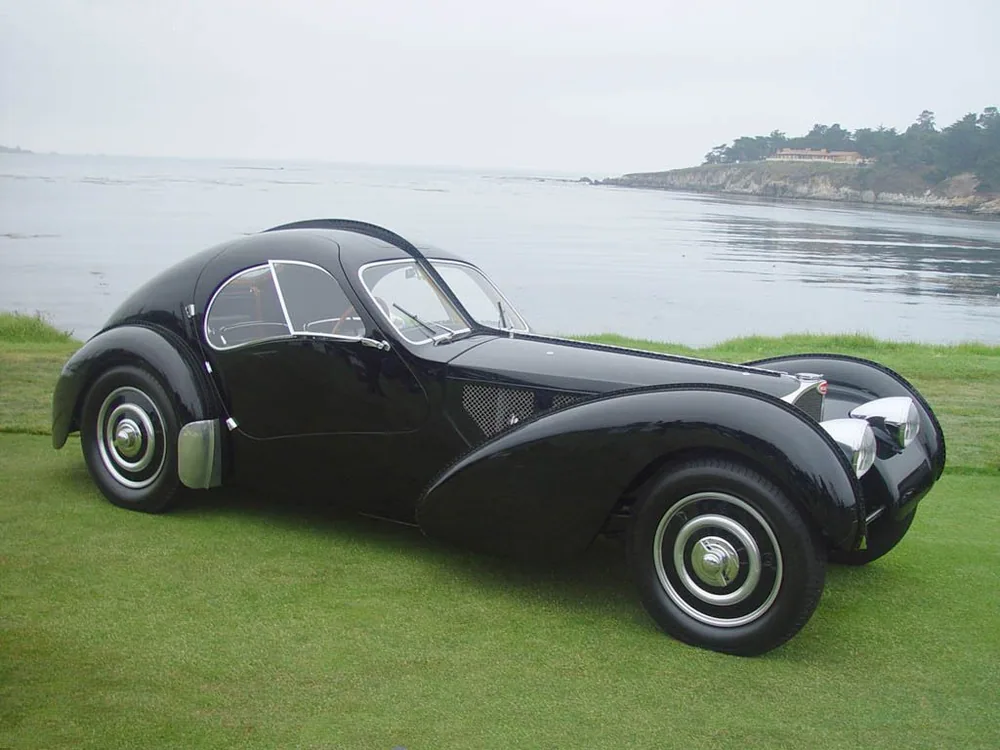
Two of the rarest pre-war Bugattis are the Type 57 Atlantic, with just four coupés built between 1936 and 1938, and the Type 41 Royale, with six built up to 1933. Three Atlantics still exist, and the fourth, La Voiture Noire, has been missing for over 80 years. All six Royales survive, and no king or queen ever took delivery of one.
How do the Atlantic and the Royale compare?
They are opposites: one is compact and light-looking, the other a giant. Neither sold in numbers, and both became legends because so few exist.
| Type 57 Atlantic | Type 41 Royale | |
|---|---|---|
| Built | 4 (1936–1938) | 6 (up to 1933) |
| Survivors | 3 | 6 |
| Engine | 3.3-litre straight-eight | 12.8-litre straight-eight |
| Output | up to 200 PS | about 300 hp at 1,800 rpm |
| Length | 3.70 m | over 6 m |
| Top speed | over 200 km/h | about 200 km/h |
These are Bugatti's published figures. The Royale's weight runs from 3 to 3.5 tonnes depending on the body and the source.
What is the Bugatti Type 57SC Atlantic?
It is the most extreme version of the Type 57, the model range Jean Bugatti built from one base car, with about 800 made of all versions by Bugatti's count (Wikipedia says 710). The Atlantic sits on the lowered 57S chassis, of which 43 were built. S stands for surbaissé (lowered) and C for compresseur (supercharger).
Strictly, most began as 57S cars. Only two 57SC cars were built with a supercharger from new, and many 57S owners later had one fitted at Molsheim.
The Atlantic grew out of the 1935 Aérolithe concept, whose panels were made of Elektron, a magnesium alloy that could not be welded. They were riveted instead, which created the raised seam along the spine. Production cars used aluminium but kept the seam for its looks. The name honours Jean Mermoz, the aviator and friend of Jean Bugatti who was lost over the South Atlantic in 1936.
What happened to the four Atlantics?
Three are accounted for, one heavily rebuilt, and one has vanished. Bugatti sold only three of them to customers.
| Chassis | First owner | Date | Status |
|---|---|---|---|
| 57374 | Victor Rothschild | 1936 | original; sold privately in 2010 |
| 57453 | Jean Bugatti | 1936 | missing; last trace 1938 or 1941 |
| 57473 | Jacques Holtzschuch | late 1936 | wrecked 1955, rebuilt |
| 57591 | R.B. Pope | 1938 | original; Ralph Lauren |
57374 was the first, supplied in grey-blue and without a supercharger. It won Best of Show at Pebble Beach in 2003. Gooding & Company arranged its private sale in 2010 without disclosing terms, and The Wall Street Journal reported $30 to $40 million. The Journal named the Mullin Automotive Museum as the buyer, which the museum denied, though later reports place the car in its collection.
57453, La Voiture Noire, was Jean Bugatti's own car, used in brochures and at shows in Lyon and Nice. Bugatti says there is no trace of it after 1938, while VeloceToday and Wikipedia cite a list of cars to be shipped to Bordeaux in 1941. Bugatti considers it more likely to have been moved to safety as the German army reached Alsace than sold to a friend. It cites expert estimates above €100 million if the car ever surfaces.
57473 was struck by a train near Gien on 22 August 1955, killing owner René Chatard and his passenger. The wreck was later rebuilt, and the result is disputed: it appeared at Pebble Beach in 2010 for display only, and Wikipedia says it was considered a replica.
57591 was the last, completed for R.B. Pope. It won Best of Show at Villa d'Este in 2013 in Ralph Lauren's ownership.
Why was the Bugatti Royale so extreme?
Because Ettore Bugatti aimed it at royal families and heads of state. He planned about 25, but the Depression cut sales and only six were built. King Alfonso XIII of Spain lost his throne in 1931 before any delivery.
The prototype had an engine of almost 15 litres, based on an aero engine design. Production cars took 12.8 litres, with a wheelbase of 4.3 metres and 24-inch wheels cast in one piece with the brake drums. The price was about ten times that of other Bugattis. The first customer, Armand Esders, paid 700,000 francs for his roadster in 1932, and the elephant on the radiator cap is by Ettore's brother, Rembrandt Bugatti.
Sources disagree on how many were sold. Bugatti says four, while Wikipedia says three went to outside customers.
Where are the six Bugatti Royales now?
All six still exist, and they came together in one place at Pebble Beach in 1985.
| Chassis | Body | Story | Where |
|---|---|---|---|
| 41100 | Coupé Napoléon | Family car, sold to Fritz Schlumpf in 1963 | Mulhouse |
| 41111 | Binder Coupé de Ville | Esders roadster, rebodied after 1938 | Volkswagen, bought 1999 |
| 41121 | Weinberger cabriolet | Dr Fuchs, 1932; found in a New York scrapyard | Henry Ford Museum |
| 41131 | Park Ward limousine | Cuthbert Foster, 1933 | Mulhouse |
| 41141 | Kellner | Sold at Christie's in 1987 for about $9.7 million | private |
| 41150 | Berline de Voyage | Sold with 41141 to Briggs Cunningham in 1950 | private |
Cunningham's 1950 purchase of the last two is the classic bargain story: 200,000 francs, about $571, plus two refrigerators.
What happened to the leftover Royale engines?
They ended up on the railway. With few cars sold, Bugatti used the engines in high-speed railcars for the French railways, detuned to about 200 hp each and used in sets of two to four. Bugatti says SNCF ordered 79 railcars with these engines, and Wikipedia records one taking a world average-speed record at 196 km/h. The failed luxury car ended up paying its way.
Test what you know in the daily Bugatti quiz, see where these cars fit on the Bugatti timeline, or read about the car that made the name in racing, the Type 35. For the modern W16 cars, see the Veyron and Chiron.
FAQ
How many Bugatti Atlantics are left?
Three of the four still exist. Two are original and the third was rebuilt after a 1955 train crash, while La Voiture Noire is still missing.
How many Bugatti Royales were made?
Six were built up to 1933, and all six survive. Bugatti had planned about 25, and no royal ever took delivery of one.
What is La Voiture Noire?
It is the second Atlantic, chassis 57453, which Jean Bugatti kept for his own use. Its name means "the black car", and it has been missing for over 80 years.
Why does the Atlantic have a seam along its spine?
The prototype's Elektron panels could not be welded, so they were riveted together with a raised seam. Production cars used aluminium but kept the seam as a styling feature.
Sources
- The Bugatti Type 57 SC Atlantic: a style icon, Bugatti Newsroom
- Bugatti legends: Type 41 La Royale, a royal vehicle, Bugatti Newsroom
- Type 41 Royale at the Goodwood Festival of Speed 2013, Bugatti Newsroom
- T57S Bugatti Atlantic reappears at Pebble Beach, VeloceToday
- Gooding & Company sells 1936 Bugatti Type 57SC Atlantic, Sports Car Digest
- Ralph Lauren's Bugatti named Best in Show at Villa d'Este, Fox News
- Bugatti Royale, Wikipedia
- Bugatti Type 57, Wikipedia
Every figure here was checked against at least two independent sources, listed at the end.