History
Charles Rolls and Henry Royce: the 1904 meeting and how it started
Charles Rolls and Henry Royce met at the Midland Hotel in Manchester on 4 May 1904, introduced by Henry Edmunds. A sales deal followed on 23 December 1904, and Rolls-Royce Limited on 15 March 1906.
By the My Hangar editorsPublished 5 min read
Key takeaways
- Charles Rolls and Henry Royce first met on 4 May 1904 at the Midland Hotel in Manchester.
- Henry Edmunds, a friend of both men, made the introduction after driving Royce's first 10 H.P. car in a trial in April 1904.
- Under an agreement dated 23 December 1904, C. S. Rolls & Co took the whole car output of the Royce firm, sold under the Rolls-Royce name.
- Rolls-Royce Limited was registered on 15 March 1906 and moved from Manchester to Derby in July 1908.
- Charles Rolls died in a flying accident at Bournemouth on 12 July 1910, six years after the meeting.
Charles Rolls and Henry Royce first met on 4 May 1904 at the Midland Hotel in Manchester, introduced by their mutual friend Henry Edmunds. On 23 December 1904 Rolls's firm agreed to sell all the cars Royce could make under the Rolls-Royce name, and on 15 March 1906 the partnership became Rolls-Royce Limited.
Who were Rolls and Royce before they met?
Rolls was a young London car dealer looking for a British car to sell; Royce was a Manchester electrical engineer who had just built his first cars. They came from opposite ends of Edwardian society.
Rolls, the third son of Lord Llangattock, read mechanical and applied science at Trinity College, Cambridge. In January 1902 he opened C. S. Rolls & Co in Fulham, importing Continental cars.
Royce started a workshop in Hulme, Manchester, in 1884, was soon joined by Ernest Claremont, moved to Cooke Street in 1888, and by the mid-1890s the business made dynamos and electric cranes. He then bought a second-hand two-cylinder Decauville, decided he could improve on it, and built three two-cylinder Royce cars. The first was finished by 1 April 1904.
| Charles Rolls | Henry Royce | Henry Edmunds | |
|---|---|---|---|
| Born | 27 August 1877 | 27 March 1863 | 20 March 1853 |
| Age on 4 May 1904 | 26 | 41 | 51 |
| Business | Car dealer, Fulham | Electrical engineer, Manchester | Partner in cable-maker WT Glover & Co |
| Part in the story | Sales and promotion | Design and engineering | The introduction |
| Died | 12 July 1910 | 22 April 1933 | 18 November 1927 |
How did Henry Edmunds bring them together?
Edmunds knew both men and saw that each had what the other needed. He had worked with Royce through Manchester electrical contracts, and he met Rolls in the 1,000 Mile Trial of 1900.
At the end of April 1904 Edmunds needed a car for the Slide Slip Trials, run to test anti-skid tyre chains made by a company he had an interest in. Rolls-Royce's heritage account says Royce lent him the first 10 H.P., which went to London by train. Edmunds drove it well, and came away convinced that it was the British car Rolls wanted.
Accounts differ on the details. Wikipedia's entry on Royce says Edmunds had bought the third Royce car and showed Rolls that one. The same entry questions the venue, calling the Great Central Refreshment Rooms near London Road Station more likely, though it flags that claim as uncited; Rolls-Royce and the Science Museum both say the Midland. All versions agree on the outcome: Edmunds arranged the meeting.
What happened at the Midland Hotel?
Very little of the conversation is recorded; what Rolls-Royce and the Science Museum give is the date, the place and the result. Rolls preferred three- and four-cylinder cars, yet the two-cylinder Royce impressed him.
Grace's Guide records a test run in one of Royce's cars during the May visit. Rolls's reaction back in London is the best-known detail: Rolls-Royce's account says he told his business partner Claude Johnson he had found "the greatest motor engineer in the world", and that he would sell all the cars Royce could make.
What did the December 1904 agreement say?
C. S. Rolls & Co, run by Rolls and Johnson, took the total car output of the Royce firm and handled bodywork and sales. The cars would carry the Rolls-Royce name.
The first cars under that name appeared at the Paris Salon that month: a 10 hp show car, a 15 hp chassis left incomplete because its engine was not ready, a 20 hp and a 30 hp engine. So the name was on public display within eight months of the meeting.
| Date | What happened |
|---|---|
| 1 April 1904 | First Royce car completed in Manchester |
| Late April 1904 | Edmunds drives the Royce in the Slide Slip Trials |
| 4 May 1904 | Rolls and Royce meet at the Midland Hotel |
| December 1904 | Rolls-Royce cars shown at the Paris Salon |
| 23 December 1904 | Sales agreement between C. S. Rolls & Co and Royce |
| November 1905 | Rolls's firm shows the Rolls-Royce at Olympia |
| 15 March 1906 | Rolls-Royce Limited registered |
| 9 July 1908 | New works opens at Nightingale Road, Derby |
| 12 July 1910 | Rolls dies at Bournemouth |
What was the first Rolls-Royce car like?
It was the 10 hp, a small two-cylinder car developed from the Royce. The engine displaced about 1.8 litres, drove through a three-speed gearbox, and the car cost £395 through Rolls's dealership.
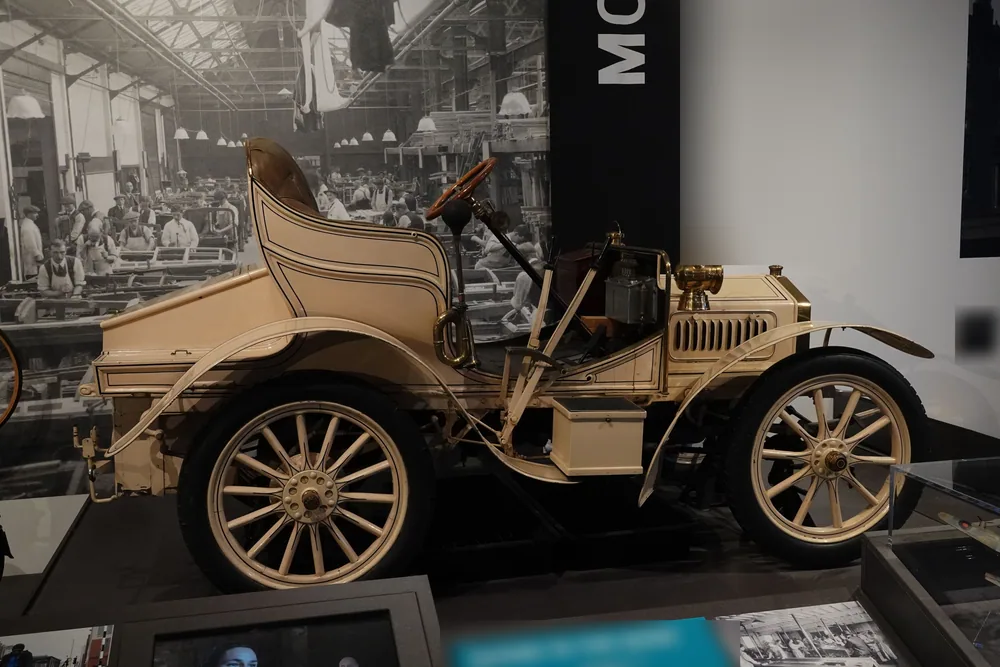
Production was short, because a twin was judged wrong for the marque. Sources give 16 or 17 cars built, from a plan of about 20. Four are believed to survive. The 1905 car in our photo, AX 148, belongs to the UK Science Museum collection and is usually shown in Manchester, while the oldest, chassis 20154, sold at Bonhams in December 2007 for more than £3.2 million.
What happened to the partnership after 1904?
It lasted barely six years. Johnson became managing director when the company was formed in 1906, and pushed the firm towards the single model that made its name, covered in our article on the Silver Ghost.
Rolls drifted towards aviation. The board turned down his idea of building Wright aeroplanes in 1909, and Grace's Guide has him resigning as technical managing director in April 1910. On 12 July 1910 the tail of his Wright Flyer broke off at a Bournemouth flying meeting, and he was killed at 32. Royce carried on as the engineering force until his death in 1933, and the mascot that followed was Johnson's project rather than the founders': see the Spirit of Ecstasy.
Try the marque's history in the daily Rolls-Royce quiz, or follow the dates on the Rolls-Royce timeline.
FAQ
When did Rolls and Royce first meet?
On 4 May 1904, at the Midland Hotel in Manchester. Rolls-Royce's history and the Science Museum both give that date and place.
Who introduced Charles Rolls to Henry Royce?
Henry Edmunds, an electrical businessman who worked with Royce in Manchester and knew Rolls from the Automobile Club of Great Britain and Ireland, later the Royal Automobile Club.
When was Rolls-Royce founded?
The sales agreement dates from 23 December 1904, but the company Rolls-Royce Limited was registered on 15 March 1906. Both dates are used, depending on whether you count the brand or the company.
What was the first Rolls-Royce car?
The two-cylinder 10 hp of 1904, built in Manchester and sold through C. S. Rolls & Co at £395. Only 16 or 17 were made.
Sources
- Makers of the Marque: Henry Edmunds, Rolls-Royce Motor Cars newsroom
- Makers of the Marque: The Hon. Charles Stewart Rolls, Rolls-Royce Motor Cars newsroom
- A momentous motoring meeting in Manchester, Science Museum blog
- Charles Stewart Rolls, Grace's Guide
- C. S. Rolls and Co, Grace's Guide
- 1904 Rolls-Royce 10 HP, Supercars.net
- Henry Royce, Wikipedia
- Rolls-Royce 10 hp, Wikipedia
Every figure here was checked against at least two independent sources, listed at the end.