Engineering
Bugatti Veyron and Chiron: how they reached 400 km/h and beyond
The Veyron passed 400 km/h at Ehra-Lessien in April 2005 with 1,001 PS. The Super Sport reached 431.072 km/h in 2010, and a modified Chiron hit 490.484 km/h in 2019, in one direction only.
By the My Hangar editorsPublished 6 min read
Key takeaways
- A Veyron 16.4 exceeded 400 km/h at Ehra-Lessien on 19 April 2005, and 407 km/h went into its type approval papers.
- The Veyron Super Sport averaged 431.072 km/h over two opposite runs in July 2010, with its customer-car limiter switched off.
- A Guinness spokesperson called the Super Sport record invalid in April 2013 over that limiter, and after a review Guinness confirmed it that same month.
- A pre-production Chiron derivative reached 490.484 km/h on 2 August 2019, but it ran in one direction only and had a roll cage.
- Customer Chiron Super Sport 300+ cars are electronically limited to 440 km/h.
The Bugatti Veyron passed 400 km/h on 19 April 2005 at Ehra-Lessien in Germany, using a quad-turbo 8.0-litre W16 making 1,001 PS. The Super Sport then averaged 431.072 km/h in 2010, and a modified Chiron derivative reached 490.484 km/h in 2019. Each step needed more power, stronger tyres and lower drag.
Why did Bugatti aim for 400 km/h at all?
Because Ferdinand Piëch, then leading the Volkswagen Group, made it the goal. Bugatti's account says he sketched an 18-cylinder engine on an envelope on a Shinkansen in 1997, and Volkswagen secured the brand rights the following year.
At the 2000 Geneva show the target became public: 1,001 PS, over 400 km/h and under three seconds to 100 km/h. Engineers then replaced the 18-cylinder plan with a W16 and four turbochargers, shown in the EB 16.4 Veyron prototype in Paris in September 2000. Series production was confirmed in 2001 and began in 2005.
How did the Veyron reach 400 km/h in 2005?
With brute power, a great deal of cooling and a special mode for top speed. The driver was Uwe Novacki, a Volkswagen instructor, on the track of almost nine kilometres at Ehra-Lessien, and TÜV Süd measured the speed in both directions.
A first attempt reached 380 km/h and a second touched 411 km/h. A digital display showed 427 km/h, later found to be a miscalculation. Type approval papers carry 407 km/h, while Wikipedia gives a TÜV average of 408.47 km/h, so you will see both.
The engine and drivetrain carried the load:
- Engine: 8.0-litre W16 with four turbochargers, 1,001 PS and 1,250 Nm.
- Drivetrain: seven-speed dual-clutch gearbox and permanent all-wheel drive.
- Cooling: ten radiators, for the engine, charge air, oil, transmission, differential and air conditioning.
What is the Veyron's Top Speed mode?
In normal use the Veyron stops at 343 km/h. To go further, the driver stops the car and turns a special key to the left of the seat, which starts a readiness checklist. The rear spoiler retracts, the front diffusers close and the ride height falls from 12.5 cm to 6.5 cm.
Why was the Veyron Super Sport's 431 km/h record disputed?
Because customer cars are limited to 415 km/h and the record car ran without that limit. In July 2010 test driver Pierre-Henri Raphanel set runs of 427.933 and 434.211 km/h at Ehra-Lessien, for an average of 431.072 km/h, witnessed by TÜV and a Guinness representative.
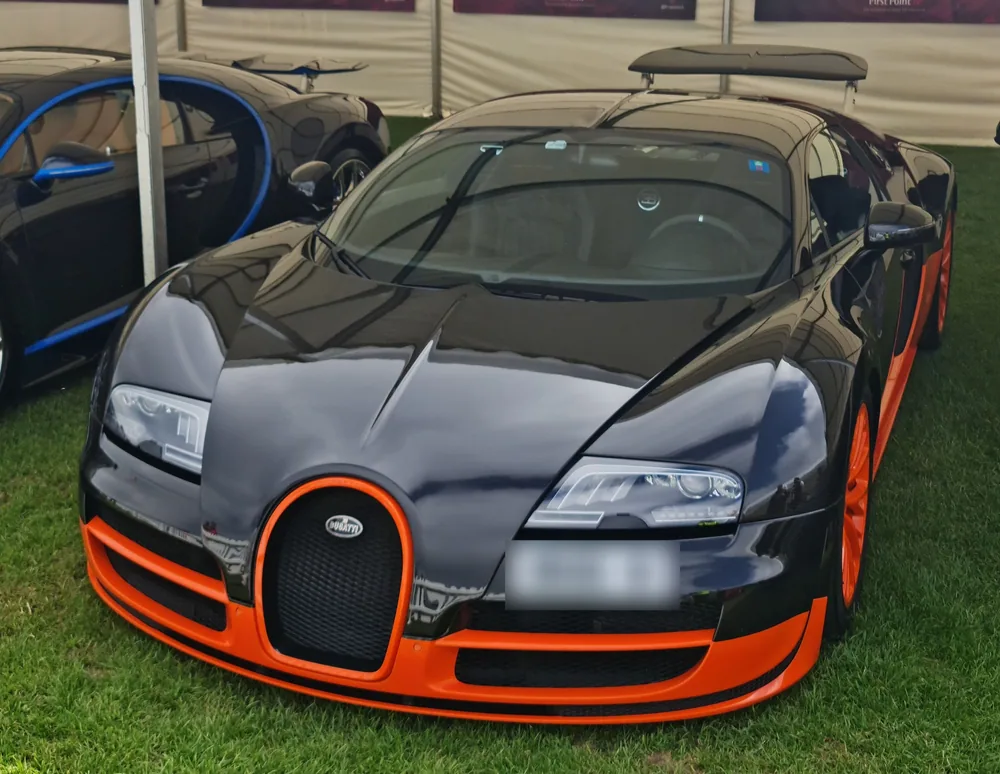
The Super Sport had 1,200 PS and 1,500 Nm, helped by larger turbochargers and intercoolers, plus NACA ducts in the roof and a double diffuser. Bugatti built 48, and the first five were World Record Editions in the record car's configuration, like the one in our photo.
In April 2013 a Guinness spokesperson said the record was no longer valid because of the limiter. Guinness then said it had not been disqualified, put the category under review and confirmed the record on 15 April, deciding the limiter did not alter the car's fundamental design. The open Grand Sport Vitesse later averaged 408.84 km/h. In total 450 Veyrons were built.
How much faster was the Chiron?
Much quicker to speed, though only slightly faster as sold. The Chiron appeared at Geneva on 1 March 2016 with 1,500 PS and 1,600 Nm from a W16 with mostly new internals and larger turbochargers. Two turbos work below 3,800 rpm and all four above it.
Its top speed is limited to 420 km/h, or about 380 km/h without the separate key. In August 2017 Juan Pablo Montoya drove one from 0 to 400 km/h and back to rest in 41.96 seconds at Ehra-Lessien, a time the Koenigsegg Regera later beat. Bugatti planned 500 cars, and the last, L'Ultime, closed the run in May 2024.
How did a Chiron reach 490 km/h in 2019?
By being a highly modified one-off rather than a customer car. On 2 August 2019 Andy Wallace reached 490.484 km/h (304.773 mph) at Ehra-Lessien, with full throttle for about 70 seconds along the 8.8 km straight. At that speed the car covered 136 metres per second.
The changes were aimed at drag and stability:
- A tail about 25 cm longer and a fixed rear wing.
- Lower ride height controlled by laser.
- 1,600 PS, with the regular gearbox and all-wheel-drive system.
- A roll cage, six-point belts and no passenger seat.
- Michelin tyres with reinforced belts, tested at up to 511 km/h and X-rayed individually.
SGS-TÜV Saar certified the speed from a sealed GPS box, and Bugatti calls it a record. Critics did not accept it as a production-car record, because Wallace drove in one direction instead of averaging two opposite runs. Bugatti then said it would leave the top-speed contest and focus elsewhere.
How do the Veyron and Chiron compare?
The table shows the claimed speed for each car and what that figure means, since limits and record runs are often confused.
| Car | Year | Power | Torque | Speed | What it means |
|---|---|---|---|---|---|
| Veyron 16.4 | 2005 | 1,001 PS | 1,250 Nm | 407 km/h | type approval figure |
| Veyron Super Sport | 2010 | 1,200 PS | 1,500 Nm | 431.072 km/h | two-way average; customer cars 415 km/h |
| Veyron Grand Sport Vitesse | 2013 | 1,200 PS | 1,500 Nm | 408.84 km/h | open-top run; 375 km/h on road |
| Chiron | 2016 | 1,500 PS | 1,600 Nm | 420 km/h | electronic limit |
| Chiron Super Sport 300+ | 2019 | 1,600 PS | not confirmed | 490.484 km/h | one-way, modified car; customer cars 440 km/h |
Test yourself on these numbers in the daily Bugatti quiz, follow the marque on the Bugatti timeline, or go back to its racing roots with the Type 35.
FAQ
Is the Bugatti Veyron the first car to pass 400 km/h?
Bugatti describes it as the first series-production car to exceed 1,000 PS and 400 km/h. The figure in its type approval papers is 407 km/h.
What is the fastest Bugatti Chiron?
The pre-production Chiron Super Sport 300+ car, which reached 490.484 km/h in 2019. It ran in one direction with a roll cage, and customer cars are limited to 440 km/h.
Why was the Veyron Super Sport record questioned?
In April 2013 a Guinness spokesperson called it invalid because customer cars have a 415 km/h limiter that was off for the run. After a review, Guinness confirmed the record on 15 April, deciding the limiter did not change the car's fundamental design.
Why do speed records need two directions?
Averaging two opposite runs cancels out the effect of wind. The Veyron Super Sport did that in 2010, and the Chiron run of 2019 did not.
Sources
- 15 years of Bugatti Veyron: how it all began, Bugatti Newsroom
- 407 km/h: a milestone in automotive history, Bugatti Newsroom
- Landspeed world record with the Veyron 16.4 Super Sport, Bugatti Newsroom
- Bugatti breaks the 300 mph barrier, Bugatti Newsroom
- Bugatti Chiron busts through 300 mph, but don't rewrite the record books just yet, GTPlanet
- Bugatti Chiron review, Evo
- Bugatti Veyron, Wikipedia
- Bugatti Chiron, Wikipedia
Every figure here was checked against at least two independent sources, listed at the end.