Engineering
McLaren F1: why Gordon Murray put the driver in the middle
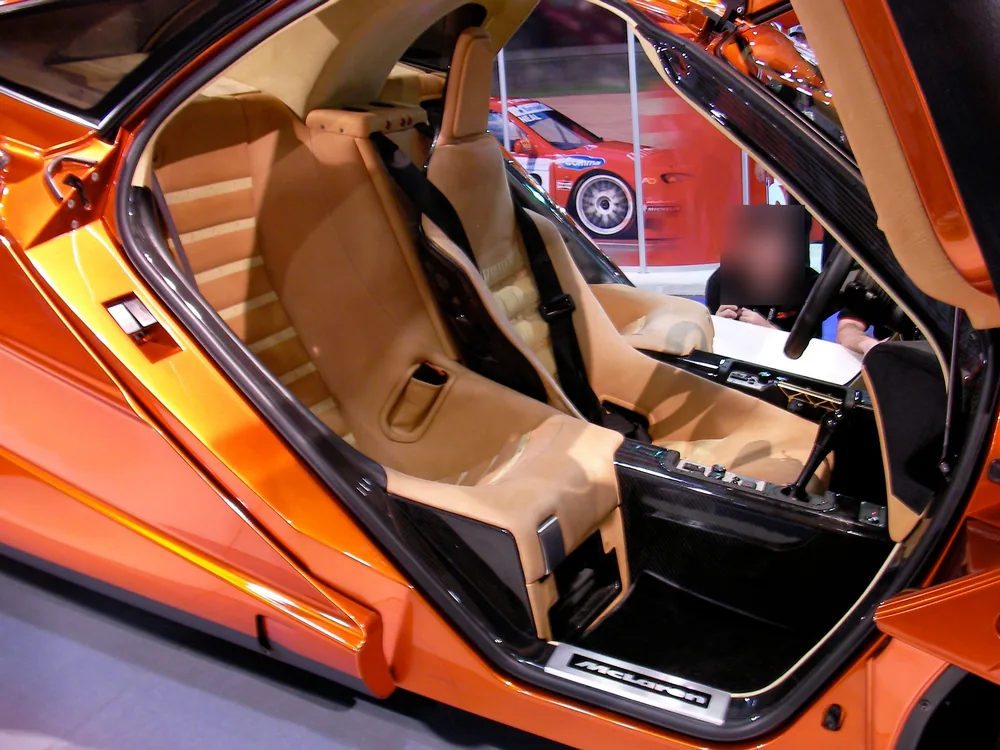
Gordon Murray centred the McLaren F1 driver to fix what he disliked in other supercars: poor visibility and offset pedals. Passengers sit slightly behind, in a car as wide as a two-seater.
By the My Hangar editorsPublished 5 min read
Key takeaways
- Gordon Murray put the McLaren F1 driver on the centreline to cure faults he listed in rival supercars, including poor visibility and offset pedals.
- The two passenger seats sit slightly behind the driver, so shoulders overlap and the car stays as wide as a two-seater.
- Murray traced the arrowhead seating to a sketch he made at college in the 1960s.
- Murray set a 1,000 kg target; the finished car weighed about 1,140 kg dry.
- McLaren built 106 F1s of all types, of which 64 were standard road cars.
The McLaren F1 has a central seat because Gordon Murray wanted to cure the faults he found in rival supercars. Sitting on the centreline gave a clear view forward and pedals in line with the driver, and it fitted three seats into the width of a two-seater. McLaren unveiled the car in 1992 and built 106, racers and prototypes included.
Why does the McLaren F1 have a central driving seat?
Because it solved several problems at once. In his book One Formula, Murray describes driving rival supercars and listing their failings, among them that you could not see out, and that the pedals were offset. A central seat dealt with both.
His own summary, in an extract published by Motor Sport, is direct: "If there was a central driving position, it negated all the horrible things you had in current supercars." He adds: "It certainly gave you fantastic control and visibility for driving fast."
On the centreline, the seat, the pedals and the steering line up symmetrically, as Sports Car Market's buyer's guide notes. Murray's comparison came from his day job as a Grand Prix designer: he says the driver is "in the middle, like a Formula 1 car".
Where did the three-seat idea come from?
The idea was older than the car. Murray says a sketch from his college days in the 1960s showed an arrowhead formation, with passengers far enough back that their shoulders went behind the driver's.
The project itself began in September 1988 at Milan's Linate Airport. Rush magazine's history places Murray there with Ron Dennis, Mansour Ojjeh and Creighton Brown after the Italian Grand Prix, and says Murray had fleshed out a four-page manifesto by the time they boarded the plane home. The car was unveiled at The Sporting Club in Monaco on 28 May 1992.
How does the seating fit in a two-seater's width?
By staggering the occupants. Murray's point is that hips are narrow and shoulders are wide, so moving the passengers back lets the three bodies overlap. He says the car came out at the same width as a two-seater.
The layout also had a value judgement built in. Murray writes that the passengers are "incidental", and evo's road test makes the same point from the driving seat: the car feels built around the person in the middle.
| McLaren F1 | Figure |
|---|---|
| Seats | Three, driver in the centre, passengers slightly behind |
| Engine | BMW S70/2, 6,064 cc naturally aspirated V12 |
| Power | 627 PS (618 bhp) at 7,400 rpm |
| Steering | Unassisted |
| Weight target | 1,000 kg |
| Dry weight as built | About 1,140 kg |
| Top speed record | 386.4 km/h (240.1 mph), 31 March 1998 |
| Total built | 106, of which 64 standard road cars |
Some sources print the output as 627 bhp. The figures of 627 PS and 618 bhp describe the same engine in metric and imperial horsepower.
What did the central seat cost?
Mainly ease of access. Evo describes the climb into the middle as a bit of a chore, though one worth the trouble.
The doors had to work with that. Murray's design for them was inspired by the Toyota Sera, a small Japanese coupé with upward-opening doors, as both Rush and Wikipedia report.
How did the layout help the rest of the car?
It supported Murray's obsession with mass. RM Sotheby's records his aims as the lightest car by miles and the best driver's car for feedback, with no power assistance. Rush adds that placing the driver ahead of the engine and gearbox improved weight distribution.
He missed the 1,000 kg target by about 140 kg, according to RM Sotheby's. Paul Rosche's naturally aspirated BMW engine made far more power than Murray had first asked for: Rush says he wanted around 450 bhp.
Andy Wallace took the XP5 prototype to a two-way average of 240.1 mph at Ehra-Lessien, with the rev limiter raised to 8,300 rpm; Sports Car Market gives 231 mph for a standard car on its 7,500 rpm limit. Three years earlier, racing versions had won the 1995 24 Hours of Le Mans at the first attempt, with further GTRs third, fourth, fifth and thirteenth.
Has any other car copied the layout?
Yes, and Murray himself is one of those who returned to it. The McLaren Speedtail, revealed in 2018 with 106 examples planned, has a three-seat layout with the driver slightly ahead of the two passengers.
Murray's own Gordon Murray Automotive T.50 keeps the idea too, as a three-seater with the driver in the middle, a 986 kg weight and a run of 100 cars. The Auto Page calls it the F1's spiritual successor.
To see how this car fits into the wider range, read McLaren road cars explained, then try the McLaren quiz or the McLaren timeline. The company's founder is covered in Bruce McLaren and the team he founded.
FAQ
Why is the driver in the middle of the McLaren F1?
Gordon Murray wanted to remove faults he had listed in rival supercars, including poor visibility and offset pedals. The centreline position gives a clear forward view and pedals straight ahead.
How many people does a McLaren F1 seat?
Three, including the driver. The two passengers sit on either side of the driver and slightly behind, which keeps the car as wide as a two-seater.
How many McLaren F1s were built?
McLaren built 106 F1s of all types between 1992 and 1998, including prototypes, LM and GT specials and GTR racers. Standard road cars are generally counted at 64.
Who designed the McLaren F1?
Gordon Murray conceived and led the project, with Peter Stevens hired to style the body and interior. Paul Rosche of BMW M developed the V12.
Sources
- Gordon Murray: I designed the McLaren F1 in my head (extract from One Formula), Motor Sport
- 30 Years of the McLaren F1, Rush
- How To Build The Ultimate McLaren F1, RM Sotheby's
- McLaren F1 (1994–1998): driving the 240mph hypercar icon, evo
- Buyer's Guide to the McLaren F1, Sports Car Market
- Is Murray's T.50 the best car ever?, The Auto Page
- McLaren F1, Wikipedia
- McLaren Speedtail, Wikipedia
- 1995 24 Hours of Le Mans, Wikipedia
Every figure here was checked against at least two independent sources, listed at the end.