Engineering
Koenigsegg engineering explained: Light Speed Transmission, Direct Drive and Freevalve
The Light Speed Transmission gives the Jesko nine gears and jumps directly between them, Direct Drive replaces the Regera's gearbox with one fixed ratio, and Freevalve removes the camshafts from an engine.
By the My Hangar editorsPublished 6 min read
Key takeaways
- The Light Speed Transmission is a nine-speed, multi-clutch gearbox that Koenigsegg says weighs 90 kg with fluids and can jump straight from 7th to 4th.
- Koenigsegg Direct Drive removes the Regera's gearbox: a hydraulic coupling and three electric motors work with one 2.73:1 ratio, equal to the Agera's 7th gear.
- Freevalve replaces camshafts with individually controlled actuators, so each valve sets its own lift, timing and duration.
- The Tiny Friendly Giant, a 2.0-litre three-cylinder Freevalve engine rated at 600 hp, was dropped from the Gemera in 2024 because too few buyers wanted it.
- The production Gemera uses a V8 and a nine-speed gearbox derived from the Light Speed Transmission, not the Direct Drive first planned for it.
Koenigsegg's three best-known ideas each remove something conventional. The Light Speed Transmission drops the flywheel and a dual-clutch gearbox's step-by-step shifting, Direct Drive drops the gearbox altogether, and Freevalve drops the camshafts. The first two reached production in the Jesko and the Regera; we found no road car on sale with the third.
What is the Light Speed Transmission?
It is a nine-speed gearbox designed and built in-house for the Jesko, in which clutches opening and closing at the same time change the gear. Koenigsegg quotes nine forward gears and seven wet, multi-disc clutches, and K.C. Colwell of Car and Driver reports its claim of 198 lb (90 kg) with all fluids.
The clutch count needs a footnote. Car and Driver lists eight in total: six for the forward gearsets, one for reverse, and one for the limited-slip differential. That matches Koenigsegg's seven once the differential clutch is set aside.
How does it change gear?
Each forward gear needs two clutches engaged, one on the countershaft and one on the output shaft, so five stay open at any moment. That simultaneous action keeps drive flowing between adjacent gears. evo describes three internal shafts carrying three gears each.
Why can it skip gears?
A dual-clutch box pre-selects one neighbouring gear and steps through the ratios one by one. The Light Speed Transmission can go straight to any gear, a function Koenigsegg calls Ultimate Power On Demand: its example is 7th directly to 4th, bypassing 6th and 5th. On the paddles, the first notch changes one gear and a further press triggers the jump.
Why has it no flywheel?
Because the input shaft connects directly to the crankshaft, and the rotating parts of the transmission do the flywheel's job. That smooths the delivery of the flat-plane V8, which makes about 1,600 hp on E85, and removes mass that would slow its response.
Treat shift times with care. Koenigsegg's site says "virtually zero" between adjacent gears and Car and Driver reports a Koenigsegg claim of two milliseconds, but both figures come from the company.
What is Koenigsegg Direct Drive?
It is the Regera's answer to the gearbox: there isn't one. Koenigsegg Direct Drive sends the engine's power to the rear axle through a single 2.73:1 ratio, which the company says equals 7th gear in the Agera.
Pulling away in a gear that tall would normally lack torque, so three things fill the gap:
- Electric motors: three axial-flux units, one on each rear wheel and one on the crankshaft. They supply torque from 0 rpm, torque vectoring and energy recovery.
- HydraCoup: an in-house hydraulic coupling, comparable to a torque converter with a lock-up. It phases in the 5.0-litre twin-turbo V8, whose rated output is 1,100 hp.
- A locked driveline: once the coupling locks, the engine drives the wheels mechanically with very low losses.
Koenigsegg quotes 1,500 hp for the whole system. With no shifts, it also needs another way to give the feel of a downshift, and the Regera simulates one by letting the HydraCoup slip. Only 80 were built.
How does Freevalve work?
It replaces camshafts with an actuator on each valve, under computer control. Each valve then chooses its own lift, timing and duration instead of following the fixed profile of a cam lobe.
Accounts of the hardware differ. Road & Track describes pneumatic actuators, and evo calls the system hydraulically actuated. Other reports describe a combination of the two, so the safe common thread is electronically controlled valves with no cam.
What does that allow?
Road & Track's technical account of the engine lists several tricks:
- No throttle: intake valve lift and duration control the airflow, and at low loads only one of the two intake valves per cylinder opens.
- Cylinder shut-off: individual cylinders can stop on the fly.
- Otto or Miller cycle: in Miller mode the intake valves stay open longer to reduce pumping losses.
- A turbo trick: below about 3,000 rpm only the exhaust valves feeding the small turbo open, sending all the exhaust through it for quick boost. Above that, the big turbo joins in.
Two-stroke running, up to about 3,000 rpm with turbo help, remained a theoretical idea at the time of that report.
Is Freevalve in a production car?
We found no road car on sale that has it. The system was built by Freevalve, formerly Cargine, a company Koenigsegg has backed financially; EngineLabs dates the first successful camless intake-valve engine, in a converted Saab 9-5, to 2008. A Qoros 3 concept showed the idea in 2016, but it never reached the road.
The best-known application is the Tiny Friendly Giant, a 2.0-litre twin-turbo three-cylinder rated at 600 hp, redlining at 8,500 rpm and making about 500 hp on regular pump fuel. It was designed for the Gemera. In July 2024, though, Motor1 reported that Christian von Koenigsegg had dropped the option because so few buyers wanted it, while engine development continued. EngineLabs named cost, reliability and valve-control complexity among the reasons camless engines remain hard to build in volume.
How do the three systems compare?
They solve different problems, and only two have reached production.
| System | First Koenigsegg use | Removes | Core hardware | Status |
|---|---|---|---|---|
| Light Speed Transmission | Jesko | Flywheel, sequential shifting | Nine gears, seven gearbox clutches | In production cars |
| Direct Drive | Regera | The gearbox | 2.73:1 ratio, HydraCoup, three motors | 80 built |
| Freevalve | Tiny Friendly Giant | Camshafts | One actuator per valve | Not in a road car on sale |
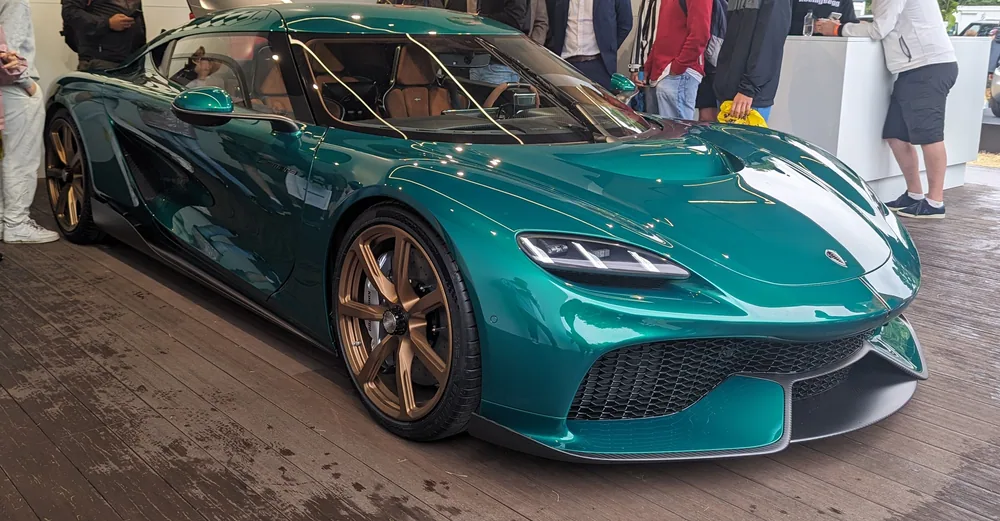
The Gemera connects all three. As first shown in 2020, it was to use the Tiny Friendly Giant with direct drive. The production car has a V8 of about 2,300 hp including its electric motor, and a nine-speed transmission derived from the Jesko's. evo reports that a single electric motor built into that gearbox replaced the earlier three, saving size and weight. For how the company reached this point, read the story of Christian von Koenigsegg and follow the Koenigsegg timeline. Then try the Koenigsegg quiz.
FAQ
How many gears does the Koenigsegg Light Speed Transmission have?
Nine forward gears. Koenigsegg quotes seven wet clutches for the gearbox, and Car and Driver counts an eighth that serves the limited-slip differential.
Does the Koenigsegg Regera have a gearbox?
No. Koenigsegg Direct Drive uses one fixed 2.73:1 ratio, with electric motors and a hydraulic coupling doing the work a gearbox would otherwise do at low speed.
What does Freevalve do?
It replaces the camshafts with an actuator on each valve. The engine computer can then control each valve's lift, timing and duration individually.
Does the Koenigsegg Gemera have a Freevalve engine?
The production plan no longer includes it. The three-cylinder Freevalve option was dropped in 2024 for lack of demand, leaving the Gemera with a V8.
Sources
- Light Speed Transmission, Koenigsegg
- Koenigsegg Direct Drive, Koenigsegg
- Regera, Koenigsegg
- Koenigsegg's Light Speed Transmission promises ultraquick shifts, Car and Driver via Yahoo Autos
- 2268bhp Koenigsegg Gemera V8 is world's most powerful production car, evo
- How Koenigsegg's 2.0-liter no-camshaft engine makes 600 horsepower, Road & Track via Yahoo Autos
- Failure to launch: what happened to the Freevalve cam-less engine?, EngineLabs
- Koenigsegg Gemera three-cylinder engine, Motor1
- Swedish company perfecting the camless engine, Driven
- Our history, Koenigsegg
Every figure here was checked against at least two independent sources, listed at the end.