History
Christian von Koenigsegg: how a Swedish start-up built a hypercar brand
Christian von Koenigsegg started his car company on 12 August 1994, aged 22. It survived empty bank accounts and a 2003 factory fire, walked away from buying Saab, and went on to set speed records.
By the My Hangar editorsPublished 6 min read
Key takeaways
- Christian von Koenigsegg started Koenigsegg Automotive on 12 August 1994, when he was 22, with no record in car manufacturing.
- His father, Jesko, gave the company a bridge loan and worked nearly full-time for it for three to four years; its first venture capital arrived in 1999.
- A fire in February 2003 destroyed the thatched factory at Margretetorp, but staff saved the cars and the company moved to a former air force base at Ängelholm.
- In November 2009 Koenigsegg, with 45 employees and 18 cars a year, dropped its bid for Saab, which had sold just over 93,000 cars in 2008.
- An Agera RS averaged 447.19 km/h in Nevada in November 2017, one of the records that made the small Swedish company famous.
Christian von Koenigsegg founded his company on 12 August 1994, aged 22, with little money and no car-making record. The first production model, the CC8S, followed in 2002. In between he ran out of funds repeatedly; afterwards came a factory fire, an abandoned bid for Saab and, in 2017, a two-way average of 447.19 km/h.
Who is Christian von Koenigsegg?
He is a Swedish entrepreneur and self-taught engineer whose interest in machines goes back to early childhood. At about five he saw The Pinchcliffe Grand Prix, a Norwegian stop-motion film about a bicycle repairman who builds a racing car and beats the odds. He told Sixty Six magazine that the car dream dated from when he was six.
As a boy he took apart radio-controlled cars and video recorders, and before he was 15 he had a local reputation for tuning mopeds.
At 19 he started a trading business to fund his patent ideas. By GT Spirit's account it resold cheap everyday goods, including misprinted plastic bags and frozen chickens. It made a decent amount of money, but at 22 he decided to go for his car dream.
How did Koenigsegg start in 1994?
With his own savings, which lasted less than a year. He then borrowed about $200,000 from a Swedish technical development board, and that went in a couple of months. GT Spirit puts the loan at 1.5 million crowns and says it required a move to an area of high unemployment, which took the company to Olofström.
What kept it alive was family. His father, Jesko, offered a bridge loan and became an adviser, then worked nearly full-time for the company for three to four years. His money ran out as well.
Christian says he then spent three years with no money at all and gave speeches and seminars to earn some. The first venture capital came in 1999. He estimates that he split those years evenly between product development and raising funds.
His wife, Halldora von Koenigsegg, became chief operating officer and called 50 suppliers to beg for time to pay in the early days. "If I've saved the company from death 50 times, so has she," he told Sixty Six.
How did the CC prototype become the CC8S?
Slowly, and with a change of engine. The CC concept was first driven in public by the racing driver Rickard Rydell at Anderstorp in 1996, and the company's timeline says it was shown at the Cannes Film Festival in 1997.
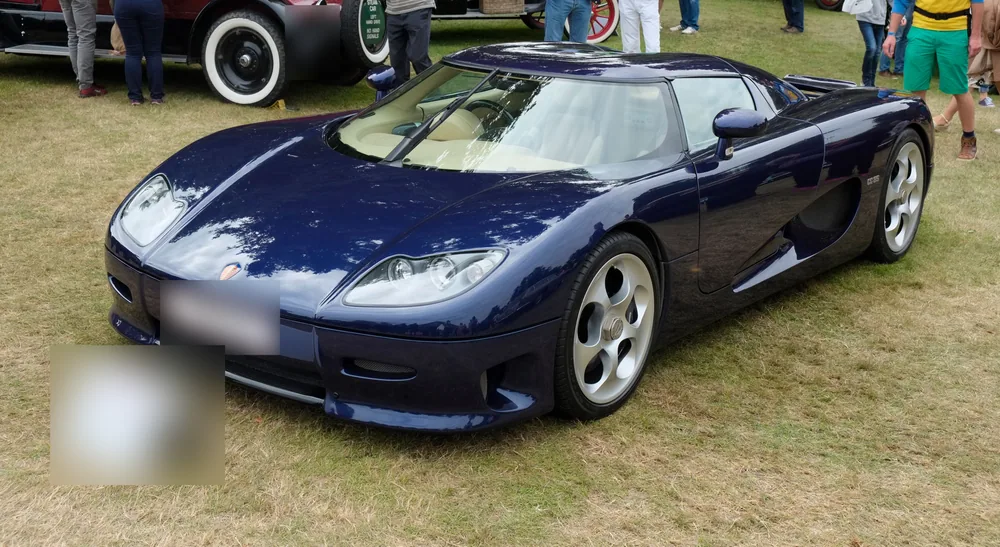
That first prototype used a standard Audi V8. Audi would not let him tune it, so he went looking for another engine partner. The search ended at Ford: the CC8S used a heavily reworked engine based on Ford's Modular V8.
The production prototype appeared at the Paris Motor Show in September 2000. Only six CC8S cars were built, in 2002 and 2003, and the car took the Guinness World Record for the most powerful production engine.
| Year | Milestone | Why it mattered |
|---|---|---|
| 1994 | Company founded, 12 August | Christian von Koenigsegg was 22 |
| 1996 | CC prototype driven at Anderstorp | First public drive, by Rickard Rydell |
| 1999 | Move to Margretetorp; first venture capital | First venture-capital backing |
| 2000 | CC8S at the Paris Motor Show | First production prototype |
| 2003 | Fire, then move to Ängelholm | New home on a former air force base |
| 2009 | Saab bid dropped | Koenigsegg stayed a small-volume maker |
| 2017 | Agera RS averages 447.19 km/h | Two-way run on a closed Nevada road |
The Koenigsegg timeline sets these events out year by year.
What happened in the 2003 factory fire?
The Margretetorp factory burned down on 22 February 2003, about two weeks before the Geneva show where the first CC8S was to be delivered. The old wooden building had a thatched roof, and it went quickly.
The Swedish magazine auto motor & sport reported that the fire service thought an espresso machine the most likely origin. Staff and firefighters rescued all of the roughly 15 cars on site, along with the tooling, but many of the company's earliest records were lost.
Its next home was better. Koenigsegg moved in 2003 to a former Swedish Air Force base at Ängelholm, taking over hangars that had housed JAS 39 Gripen fighters, along with the runway. The departing Johan Röd squadron, known as the Ghost Squadron, let the company use its emblem, and a ghost has been on the cars ever since.
What happened when Koenigsegg tried to buy Saab?
It agreed in 2009 to take Saab Automobile from General Motors, in a very lopsided deal. Koenigsegg had 45 employees and built 18 cars a year. Saab sold just over 93,000 cars worldwide in 2008 and employed 3,400 people in Sweden.
China's BAIC joined the bid that September, but the deal still needed a loan of 400 million euros from the European Investment Bank. On 24 November 2009, with the Swedish government still undecided on guaranteeing that loan, Koenigsegg withdrew, citing delays that had left the deal too uncertain. GM said it was disappointed.
How did the brand earn its reputation?
By publishing numbers that larger rivals found hard to ignore, from cars built in tiny runs. Each model also became a showcase for ideas developed in-house, such as those in our guide to Koenigsegg engineering.
- CCR, 2005: 387.86 km/h at Nardò, beating the McLaren F1. Fourteen were built.
- One:1, 2014: 1,360 hp and a 1,360 kg kerb weight, the 1:1 ratio its maker had been chasing. Seven cars, including one kept for factory development.
- Regera, 2015: three electric motors with a twin-turbo V8, and no gearbox. Eighty were built.
- Agera RS, 2017: 447.19 km/h two-way average, set by the factory driver Niklas Lilja.
- Jesko, 2019: named in honour of Christian's father and first shown at Geneva.
- Gemera, 2020: the first four-seater from the marque, limited to 300 cars, with production starting in 2026.
The company has grown with those cars. Its Gripen Atelier, opened in 2023, added 10,000 square metres at Ängelholm. If you want to test what you have just read, the Koenigsegg quiz covers this story and the models that came out of it.
FAQ
When was Koenigsegg founded?
Christian von Koenigsegg started Koenigsegg Automotive on 12 August 1994, when he was 22. The first CC8S was built in 2002.
What film inspired Christian von Koenigsegg?
The Pinchcliffe Grand Prix, a Norwegian stop-motion film he saw at about five. It tells the story of a bicycle repairman who builds his own racing car and wins.
Who is the Koenigsegg Jesko named after?
Christian's father, Jesko von Koenigsegg, who lent money to the young company and worked for it nearly full-time for three to four years in the 1990s.
Did Koenigsegg buy Saab?
No. It agreed to buy Saab from General Motors in 2009 but withdrew on 24 November that year, citing delays in completing the deal.
Where is Koenigsegg based?
At Ängelholm in southern Sweden, on a former Swedish Air Force base. The company moved there in 2003, after a fire destroyed its factory at Margretetorp.
Sources
- Our history, Koenigsegg
- About, Koenigsegg
- Sadair's Spear, Koenigsegg
- Interview with Christian von Koenigsegg, Sixty Six
- Koenigsegg: How it all started, from RC cars to hypercars, GT Spirit
- Brand totalförstörde Koenigseggs bilfabrik, auto motor & sport
- GM "disappointed" at termination of planned Saab sale, IndustryWeek
- Christian von Koenigsegg, Wikipedia
- Koenigsegg, Wikipedia
- Koenigsegg CC8S, Wikipedia
- Koenigsegg Gemera, Wikipedia
Every figure here was checked against at least two independent sources, listed at the end.