Models
Ferrari F40: the last car Enzo approved, its story and what made it special
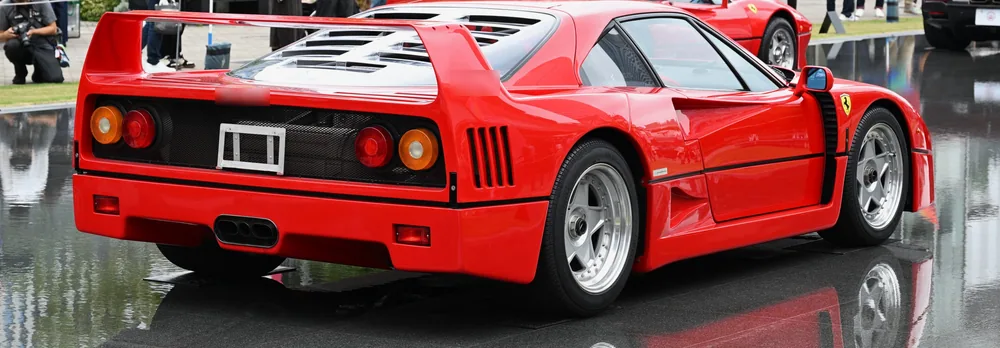
The F40 of 1987 was the last Ferrari Enzo personally commissioned and approved: a 2.9-litre twin-turbo V8 with 478 hp in a composite-bodied car of 1,100 kg dry. Ferrari planned 400 and built 1,311.
By the My Hangar editorsPublished 5 min read
Key takeaways
- Ferrari presented the F40 on 21 July 1987 as part of its 40th anniversary celebrations.
- Ferrari describes the F40 as the last car personally commissioned and approved by Enzo Ferrari, who died on 14 August 1988.
- The F40 used a 2,936 cc twin-turbo V8 making 351.5 kW (478 hp), and Ferrari quotes 1,100 kg dry and a top speed of 324 km/h.
- Ferrari intended to build about 400 F40s and ended with 1,311 by the close of production in 1992.
- Magazine tests of the period measured the F40 at 315 to 321 km/h, below the 324 km/h Ferrari claimed.
The Ferrari F40 was presented on 21 July 1987 for the company's 40th anniversary, and Ferrari calls it the last car Enzo Ferrari personally commissioned and approved before his death in August 1988. Its formula was a 2.9-litre twin-turbo V8 with 478 hp in a composite-bodied car weighing a claimed 1,100 kg dry. Ferrari planned about 400 and built 1,311.
Was the F40 really the last Ferrari Enzo approved?
Yes, on Ferrari's own account. Its magazine calls the F40 the last Ferrari he personally commissioned and approved, and its model page adds that it was the last car unveiled to the public in his presence.
Enzo Ferrari was 89 when the car appeared, and he died on 14 August 1988, about a year later. The car's name came from the same moment: F for Ferrari and 40 for the anniversary of the first Ferrari road car. If you want to decode the rest of the range, read our guide to how Ferrari model names work.
Where did the F40 come from?
It grew out of the 288 GTO and its Evoluzione development car. Ferrari's magazine describes the Evoluzione as a stepping stone to the F40.
The engineer behind that line was Nicola Materazzi, hired by Enzo Ferrari in 1979 as a turbocharging specialist. He oversaw the team that developed the GTO, which was designed as a Group B racer and became a road car when the series was cancelled. The GTO sold so well that Enzo wanted a successor, and Ferrari says the F40 was developed in less than a year.
The shape came from Pininfarina. Ferrari's magazine credits the body design to Pietro Camardella, with chief designer Leonardo Fioravanti recalling heavy wind-tunnel work and Aldo Brovarone's rear wing. The car appears at its point in the marque's story on the Ferrari timeline.
What were the Ferrari F40's specs?
A rear-mid-mounted 90-degree V8 with two turbochargers, a five-speed gearbox and no driver aids. These are Ferrari's published figures.
| Specification | Ferrari F40 |
|---|---|
| Engine | 2,936 cc twin-turbo 90° V8 |
| Valves | Four per cylinder, twin overhead camshafts per bank |
| Maximum power | 351.5 kW (478 hp) at 7,000 rpm |
| Maximum torque | 577 Nm at 4,000 rpm |
| Gearbox | 5-speed manual, rear-wheel drive |
| Frame | Tubular steel and composites |
| Weight | 1,100 kg (dry, Ferrari's figure) |
| 0–100 km/h | 4.1 seconds |
| 0–1,000 m | 20.9 seconds |
| Top speed | 324 km/h (claimed) |
| Length / width / height | 4,358 / 1,970 / 1,124 mm |
Be careful with the weight. Ferrari's specification sheet says 1,100 kg dry, but one of its own magazine features says 1,250 kg dry, and the 1,254 kg often quoted elsewhere is a European kerb figure.
What made the F40 so special?
Mainly what it used and what it left out. It was the first Ferrari production car with body panels mostly in composites, and it arrived with almost no road-car comfort.
Kevlar panels were bonded to a tubular steel spaceframe, while the doors, bonnet and boot lid were carbon fibre. The body was only eleven pieces, thanks to large one-piece front and rear sections. The engine block, heads and cam covers were cast in alloy at Maranello, and the crankshaft was machined from a solid billet.
Inside, the list of omissions is the point:
- no ABS, power steering or power-assisted brakes
- no carpet, door trim or conventional interior door handle, just a pull cord
- sliding plastic windows on roughly the first 50 cars, then wind-up windows
Even Ferrari's Formula 1 driver of the day was wry about it. Ferrari's magazine reports Gerhard Berger saying the car was "very easy to drive… if you are experienced with racing cars." You can test what you remember in the daily Ferrari quiz.
Was the F40 the first car to reach 200 mph?
That claim is Ferrari's, and the evidence is mixed. Ferrari's 324 km/h is 201 mph, but the period road tests collected on Wikipedia came in lower.
Road & Track measured 315 km/h and Car and Driver 317 km/h, while the two cars Ferrari sent to an Auto, Motor und Sport shootout at Nardò reached no more than 321 km/h, or 199 mph. Ferrari's 2017 feature also says the F40 claimed to be the first road car past 300 km/h, yet Auto, Motor und Sport and Road & Track both measured the Porsche 959 at 318 to 319 km/h in 1987. So it is safest to say the F40 was claimed to do 324 km/h and was among the fastest road cars of its time.
How many F40s were built, and what did they cost?
Ferrari's figure is 1,311, with production ending in 1992. That was more than three times the roughly 400 Ferrari first intended, and 213 cars went to the US.
Ferrari gives a list price of £193,000, while RM Sotheby's puts the 1987 US figure at about $400,000. By the end of the 1980s, early cars were changing hands privately for more than £1 million.
The racing story is smaller. Michelotto of Padua built the F40 LM, with Da Corsa counting 19 chassis (18 new plus one converted pre-production car) and two racing in the IMSA series in 1989 and 1990. Jean Alesi finished third on its debut at Laguna Seca on 15 October 1989, but despite the LM badge, Da Corsa says that series never raced at Le Mans. The later F40 GTE did: its best result was 18th in 1995, and all three entries retired in 1996. Ferrari's Le Mans record was written by other cars. The twin-turbo V8 also remained Ferrari's last forced-induction engine until the California T of 2014.
FAQ
How much horsepower does a Ferrari F40 have?
Ferrari quotes 351.5 kW (478 hp) at 7,000 rpm from its 2,936 cc twin-turbo V8, with 577 Nm of torque at 4,000 rpm.
How many Ferrari F40s were made?
Ferrari states that 1,311 cars left Maranello before production ended in 1992. It originally intended to build about 400.
Why is it called the F40?
F stands for Ferrari and 40 marks the 40th anniversary of the first Ferrari approved for road use, which the company celebrated in 1987.
Did Enzo Ferrari see the F40?
Yes. Ferrari says it was the last car unveiled in his presence, in 1987, and the last he personally commissioned and approved. He died on 14 August 1988.
Sources
Every figure here was checked against at least two independent sources, listed at the end.