Models
Bentley Continental: from the 1952 R Type to the modern GT
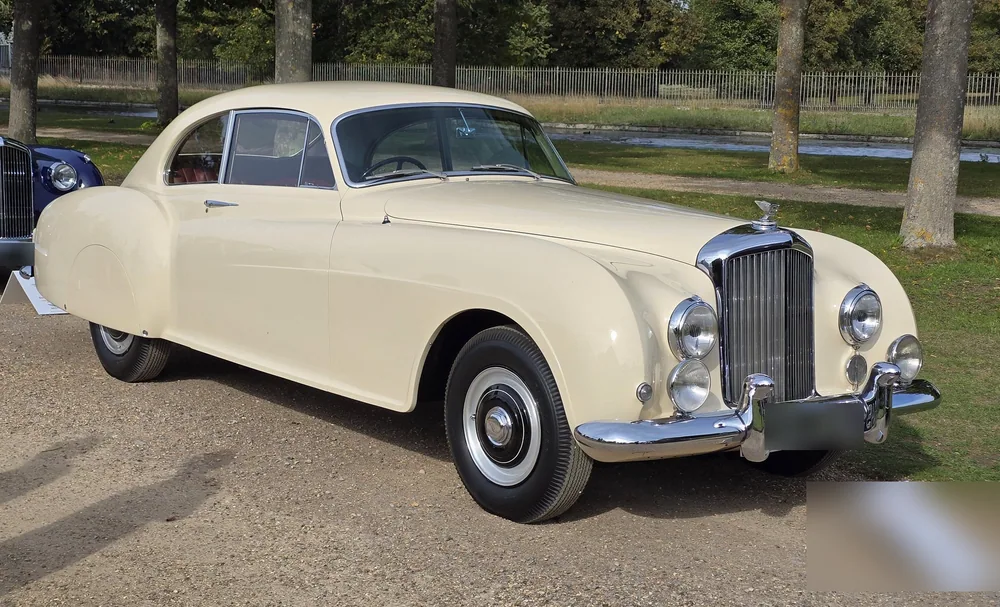
The Bentley Continental began in 1952 as a fast R Type coupé, 208 built. The name survived on S-series coupés, returned in 1984 and 1991, and since 2003 has meant the Continental GT.
By the My Hangar editorsPublished 5 min read
Key takeaways
- The first Bentley Continental was the R Type Continental, delivered from June 1952; 208 were built including the prototype, 193 of them bodied by H.J. Mulliner.
- Continental versions of the S1, S2 and S3 followed from 1955 to 1966, with about 1,130 more cars, all coachbuilt.
- The name came back in 1984 on a convertible and in 1991 on the Continental R, a two-door with a body not shared with any Rolls-Royce.
- The 2003 Continental GT was the first all-new Bentley under Volkswagen, with a 6.0-litre twin-turbo W12 making 560 PS.
- The fourth-generation GT of 2024 dropped the W12 for a 4.0-litre V8 plug-in hybrid with 782 PS in Speed form.
The Bentley Continental began in 1952 as a light, fast R Type coupé, mostly bodied by H.J. Mulliner, with 208 built. The name then lived on S-series coachbuilt cars until 1966, returned on a 1984 convertible and the 1991 Continental R, and since 2003 has meant the Continental GT, now in its fourth generation with a hybrid V8.
What was the first Bentley Continental?
The first was the R Type Continental, a two-door fastback built on the running gear of the R Type saloon. Bentley's own heritage record dates the first delivery to June 1952 and the end of production to 1955.
It was a low-volume car from the outset. The regular R Type reached 2,323 examples, coachbuilt cars included; the Continental, 208 including the prototype. H.J. Mulliner bodied 193 of them in aluminium, and the rest came from Park Ward, Franay, Graber and Pininfarina.
Why was the R Type Continental so fast?
Because it was light and shaped for speed as much as because of its power. The project team, led by Rolls-Royce project engineer Ivan Evernden, set a kerb weight limit of 34 hundredweight (about 1,700 kg) and used a wind tunnel on the shape. H.J. Mulliner's Stanley Watts finalised the styling; Bentley's own record also credits stylist John Blatchley.
The engine was a 4,566 cc straight-six with a raised compression ratio and taller gearing, quoted at 153 bhp. From July 1954 it grew to 4,887 cc.
The target was 120 mph. The prototype, OLG 490, nicknamed Olga, averaged 118.75 mph over five laps at Montlhéry, with a best lap just under 120 mph. Bentley's record quotes a production top speed of 115 mph, so 120 mph is best read as the goal.
RM Sotheby's calls it the world's fastest production four-seater in 1953, and Bentley's record the fastest four-seat luxury saloon. Neither is an independent test; The Autocar, for its part, likened it to a modern magic carpet.
What happened to the Continental in the S-series?
It became a coachbuilt chassis option. The S1 Continental followed the saloon in 1955, with the same 4,887 cc six, higher performance and lighter bodies from H.J. Mulliner, Park Ward, James Young and others. In 1957 H.J. Mulliner added a four-door body, the first Continental Flying Spur.
The S2 Continental of 1959 took the new 6,230 cc aluminium V8 shared with the Silver Cloud II. The S3 Continental of 1962 kept it with more compression and more power. Its bodies came mainly from Mulliner Park Ward, which built 291 of the 311 cars. The last S3 was delivered in 1966.
| Model | Years | Engine | Built |
|---|---|---|---|
| R Type Continental | 1952–55 | 4,566 cc, later 4,887 cc six | 208 |
| S1 Continental | 1955–59 | 4,887 cc six | 431 or 432 |
| S2 Continental | 1959–62 | 6,230 cc V8 | 388 |
| S3 Continental | 1962–66 | 6,230 cc V8 | 311 |
| Continental (convertible) | 1984–95 | 6,750 cc V8 | 421 |
| Continental R | 1991–2003 | 6,750 cc turbo V8 | about 1,500 |
| Continental T | 1996–2002 | 6,750 cc turbo V8 | 350 |
Why did the Continental name disappear and return?
It faded when the monocoque T series replaced the S3 in 1965. For more on those shared years, read Bentley and Rolls-Royce.
The two-door Mulliner Park Ward T of 1966 became the Corniche in 1971, and in 1984 its Bentley convertible took the name Continental. It was built until 1995, with 421 made.
What was the Continental R?
It was the car that gave Bentley its own shape back. Shown at the 1991 Geneva motor show, it used the Turbo R's chassis and turbocharged 6¾-litre V8 under a two-door body by John Heffernan and Ken Greenley.
Sources disagree on how long the wait had been. Bentley's record calls it the first with a unique body since the 1952 R Type Continental; other accounts count from 1965. Either way, no Rolls-Royce wore it. Power rose over the years, and the shorter Continental T of 1996, launched with 400 bhp, reached 420 bhp. The convertible sister, the Azure, arrived in 1995, and the last Continental R was built in 2003.
How has the Continental GT changed across four generations?
The W12 gave way first to an optional V8 and then to a hybrid. The first arrived after Bentley became a Volkswagen Group brand: it was shown at the Paris motor show in 2002, built from March 2003, and shared the D1 platform of the Volkswagen Phaeton. It also introduced Bentley's W12.
| Generation | Years | Platform | Engines | Headline power |
|---|---|---|---|---|
| First | 2003–2011 | D1 | 6.0 W12 | 560 PS |
| Second | 2011–2018 | D1 | 6.0 W12, 4.0 V8 | up to 710 PS (Supersports) |
| Third | 2018–2024 | MSB | 6.0 W12, 4.0 V8 | 635 PS at launch |
| Fourth | 2024– | MSB | 4.0 V8 plug-in hybrid | 782 PS (Speed) |
The first GT reached 318 km/h. The third generation moved to the MSB platform also used by the Porsche Panamera, with an eight-speed dual-clutch gearbox.
The W12 stopped in 2024 after more than 100,000 engines. Its fourth-generation replacement pairs a 4.0-litre twin-turbo V8 with an electric motor for 1,000 Nm, a 25.9 kWh battery and about 81 km of electric range. In Speed form the claim is 0–100 km/h in 3.2 seconds and 335 km/h, though at 2,459 kg it weighs 186 kg more than the W12 car.
Follow the line in our Bentley timeline, then see if you can name each one in the My Hangar Bentley quiz. The racing years sit in The Bentley Boys and Le Mans.
FAQ
How many Bentley R Type Continentals were made?
208 including the prototype, or 207 production cars, between 1952 and 1955. H.J. Mulliner bodied 193 of them, according to Bentley's heritage record.
Was the first Continental GT the first car with that name?
No. The name dates from the 1952 R Type Continental, and it had also been used on the S-series, a 1984 convertible and the 1991 Continental R.
Does the current Continental GT still have a W12?
No. W12 production ended in 2024. The fourth-generation GT uses a 4.0-litre V8, as a plug-in hybrid in the Speed and base models, and without hybrid assistance in the Supersports.
Is the Continental GT related to a Porsche?
The third and fourth generations use Volkswagen Group's MSB platform, which also underpins the Porsche Panamera.
Sources
- 1953 R Type Continental JAS 949, Bentley heritage collection
- Bentley R Type, Wikipedia
- 1958 S1 Continental Flying Spur VGX 853, Bentley heritage collection
- Bentley S3, Wikipedia
- Bentley Continental R, Wikipedia
- Bentley Continental GT, Wikipedia
- End of an era as final Bentley W12 engine hand-built in Crewe, The Manufacturer
- Bentley Continental GT Speed 2024 review, Motoring Research
- 2003 Continental R C1 BML, Bentley heritage collection
- 1953 Bentley R-Type Continental, RM Sotheby's
Every figure here was checked against at least two independent sources, listed at the end.