Models
Lamborghini Miura and Countach: how two cars defined the supercar
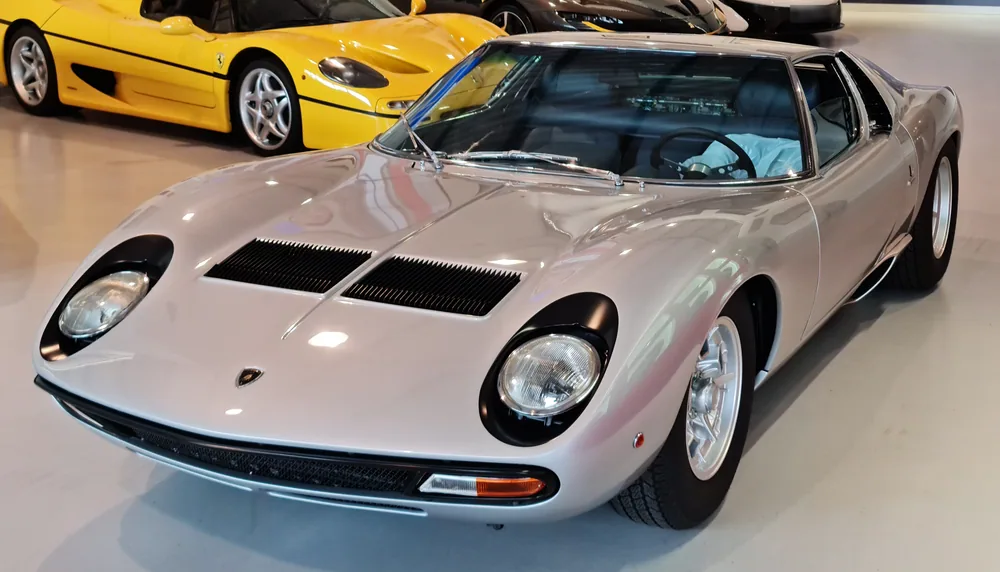
The 1966 Miura set the formula, a low mid-engined V12 road car. The Countach, shown in 1971 and on sale from 1974, added the wedge shape and scissor doors that made the supercar look the way it still does.
By the My Hangar editorsPublished 6 min read
Key takeaways
- The Miura appeared as a rolling chassis at Turin in November 1965 and as a bodied prototype at Geneva in March 1966, designed around a transverse 3.9-litre V12 behind the cabin.
- Only two mid-engined road cars preceded it, according to evo, and neither made much more than 100 bhp against the 350 bhp claimed for the Miura.
- Marcello Gandini of Bertone styled both cars, moving from the curves of the Miura to the sharp wedge of the Countach.
- The Countach was shown as the LP500 prototype at Geneva in 1971 and entered production in 1974 as the 3.9-litre LP400.
- Records list 764 Miuras and about 2,000 Countachs: Lamborghini says 1,999, while a Wikipedia tally gives 1,983.
The Lamborghini Miura of 1966 fixed the supercar formula: a low two-seater with a large V12 mounted behind the cabin. The Countach, shown in 1971 and sold from 1974, gave that formula its visual language with a sharp wedge and scissor doors. Marcello Gandini styled both. Records list 764 Miuras and about 2,000 Countachs.
Why is the Miura called the first supercar?
Because, on evo's count, no earlier road car had combined the mid-engined layout with serious power. Who made the first supercar is still debated. Evo points out that the term itself is decades older, but argues that the Miura fits the modern definition better than anything before it.
Evo counts only two earlier mid-engined road cars: the René Bonnet Djet of 1962 and the De Tomaso Vallelunga of 1964. Both used in-line four-cylinder engines and neither made much more than 100 bhp. The Miura claimed 350 bhp, and no other 12-cylinder mid-engined road car arrived for six years, until the flat-12 Ferrari 365 GT4 BB.
How did the Miura come about?
It began as an after-hours project by young engineers. Giampaolo Dallara and Paolo Stanzani, both 29 according to evo, and test driver Bob Wallace, 27, wanted a road car with racing pedigree and hoped it would persuade Ferruccio Lamborghini to go racing. Ferruccio let them proceed because he saw it as a possible marketing tool.
They named the Ford GT40 and the Mini as inspirations, the first for packaging and height, the second for its drivetrain. Ferruccio's wife owned a Mini, which they borrowed and studied.
- November 1965, Turin: a rolling chassis, project L105, with a 125 kg folded-steel structure and the V12 and gearbox mounted transversely.
- Winter 1965-66: Gandini, 27, working for Bertone, took the design from first sketch to finished form in about three months.
- March 1966, Geneva: the orange P400 appeared on the Bertone stand. Wikipedia reports that nobody had found time to check whether the engine fitted, so the bay was filled with ballast and the cover kept locked.
- December 1966: the first customer car was delivered, according to evo.
Both Ferruccio and Nuccio Bertone guessed at 50 sales when asked at Geneva, and the first order was for just 15 bodies. Production ran to 1973.
How many Miuras were built?
The usual total is 764, and the split is less certain than that precise figure suggests. The S and SV counts agree between sources, but the P400 does not: evo gives 256, Lamborghini's history page 265 and Wikipedia 275. The figures also do not add up to 764 in any of them.
| Version | Years | Power | Built |
|---|---|---|---|
| P400 | 1966–1968 | 350 CV at 7,000 rpm | Sources give 256, 265 or 275 |
| P400 S | 1969–1971 | 370 CV at 7,700 rpm | 338 |
| P400 SV | 1971–1973 | 385 CV at 7,850 rpm | 150 |
Years and power are as Lamborghini lists them; Wikipedia dates the first S cars to December 1968. Enrico Maffeo, head of the company's historic centre, told the FIA's AUTO magazine that the exact number remains unclear, because repairs could change a body while keeping its chassis number. Evo adds that a few specials sit outside these numbers, notably Wallace's 440 bhp Jota.
What did the Countach change?
It replaced flowing curves with geometry, and it turned the engine round. Where the Miura mounted its V12 across the car, the Countach placed it lengthwise, which is what the LP in its name means: longitudinale posteriore, or longitudinal rear.
Gandini had been developing the angular style on the 1968 Alfa Romeo Carabo and 1970 Lancia Stratos Zero concepts, and the scissor doors had first appeared on the Carabo. Lamborghini's history page calls them an absolute novelty for a production car in 1974.
The route to production was bumpy. The yellow LP500 prototype of 1971 had a five-litre engine that, according to Supercar Nostalgia, blew during testing that year. Production cars reverted to a 3.9-litre V12 of 375 CV, slightly less than the last Miura.
| Version | Year | Engine | What changed |
|---|---|---|---|
| LP500 | 1971 | 5.0-litre V12 | Prototype, Geneva |
| LP400 | 1974 | 3.9-litre V12 | First production car, nicknamed Periscopio |
| LP400 S | 1978 | 3.9-litre V12 | Wide Pirelli tyres and arch extensions, optional rear wing |
| 5000 S | 1982 | 4.8-litre V12 | Larger engine, more torque |
| 5000 Quattrovalvole | 1985 | 5.2-litre V12 | Four valves per cylinder, 455 CV with carburettors |
| 25th Anniversary | 1988 | 5.2-litre V12 | Restyled by Horacio Pagani, about 650 built |
Totals differ here too. Lamborghini states 1,999 cars, Wikipedia tallies 1,983, and RM Sotheby's says just short of 2,000. The model stayed in production until the Diablo replaced it in 1990.
How did the two cars define the supercar?
Together they set the template that later cars followed. The two contributions are different, which is why both are usually named.
| Feature | Miura | Countach |
|---|---|---|
| Public debut | Geneva, March 1966 | Geneva, 1971 |
| Production | 1966–1973 | 1974–1990 |
| Engine layout | Transverse mid-mounted V12 | Longitudinal mid-mounted V12 |
| Styling | Flowing curves | Sharp wedge |
| Signature feature | Low nose, headlamp "eyelashes" | Scissor doors |
| Lasting contribution | The mid-engined V12 road car | The look of the supercar |
Wikipedia describes the Miura's rear mid-engined, rear-wheel-drive layout as now standard for performance cars, while the Countach's scissor doors carried over to many later Lamborghinis. Lamborghini itself says the Countach's wedge characterised super sports cars from the mid-1970s through the 1980s.
Ferruccio remained attached to the first of them. Speaking of his retirement, as quoted by the FIA's AUTO magazine, he said: "But when I miss the sound and the fury I take refuge in my garage and turn the key in the ignition of my Miura."
For the founder's side of the story, read what is documented about Ferruccio and Enzo Ferrari. The Miura also began the bull-naming habit explained in Lamborghini naming: bulls, fighting and the model names. Then see how much you remember in the My Hangar Lamborghini quiz, or place both cars on the Lamborghini timeline.
FAQ
Was the Lamborghini Miura the first supercar?
It is the car most often given the title, but the question has no settled answer. Evo notes that the word is older and that other cars have a claim, while arguing that the Miura best fits the modern definition of a low, mid-engined car, typically with eight or more cylinders.
What does LP mean on a Countach?
LP stands for longitudinale posteriore, Italian for longitudinal rear, describing the engine's position. The number after it originally indicated nominal displacement, as with LP400 for the 3.9-litre car.
How many Lamborghini Countachs were made?
About 2,000. Lamborghini states 1,999 and a Wikipedia tally gives 1,983, so the total depends on the source and on what is counted.
Who designed the Miura and the Countach?
Marcello Gandini of Carrozzeria Bertone styled both. The Miura's chassis was developed by Giampaolo Dallara and Paolo Stanzani with test driver Bob Wallace.
Sources
- Lamborghini Miura: how the original supercar was willed into existence, evo
- From AUTO #17: Beautiful vision, FIA
- Miura history, Automobili Lamborghini
- Countach history, Automobili Lamborghini
- 1989 Lamborghini Countach 25th Anniversary Edition, RM Sotheby's
- Lamborghini Countach LP500, Supercar Nostalgia
- Lamborghini Miura, Wikipedia
- Lamborghini Countach, Wikipedia
Every figure here was checked against at least two independent sources, listed at the end.