Models
Porsche 924, 944, 928 and 968: the transaxle era explained
From 1976 to 1995 Porsche built front-engined transaxle cars: the 924, 928, 944 and 968. Porsche figures add up to about 386,000 cars, with the gearbox at the rear for balance.
By the My Hangar editorsPublished 6 min read
Key takeaways
- A transaxle Porsche has its water-cooled engine at the front and its gearbox at the rear axle, joined by a shaft running inside a rigid central tube.
- The 924 began as Volkswagen development order EA 425 of March 1972; VW cancelled it in late 1974 and Porsche bought the design.
- The V8 928 premiered in Geneva in March 1977 and won the 1978 Car of the Year award, still the only sports car to do so.
- Porsche gives production totals of 150,684 for the 924, 163,302 for the 944, 61,056 for the 928 and 11,245 for the 968.
- The transaxle era ended in 1995, when both the 928 and the 968 went out of production.
Porsche's transaxle cars are the 924 (1976–1988), 928 (1977–1995), 944 (1981–1991) and 968 (1991–1995). All four put a water-cooled engine at the front and the gearbox at the rear axle to balance the weight. Using Porsche's own totals, 150,684 924s, 163,302 944s, 61,056 928s and 11,245 968s were built: about 386,000 cars in 20 years.
What does "transaxle" mean on a Porsche?
It means the gearbox is mounted at the rear axle while the engine sits at the front. The name combines "transmission" and "axle".
On the Porsche transaxle cars, a driveshaft runs inside a rigid central tube that links the engine to the rear-mounted transmission and differential. Porsche notes that the tube also helps passive safety by carrying crash forces along the car.
Why did Porsche build front-engined transaxle cars?
For balance. Splitting the heavy engine and gearbox between the two ends of the car brings the axle loads close to even, which Porsche describes as ideally 50:50.
An even split reduces the tendency to oversteer or understeer and makes the car easier to control at the limit. Porsche's own engineers point to the roadholding and high-speed stability it gave the 924 and 944.
There was also a strategic reason. After 13 years of the 911, Porsche judged that the rear-engined car had reached the end of its development potential, and the front-engined, water-cooled 928 was planned as its eventual successor.
How was the Porsche 924 born?
As a Volkswagen project. In March 1972 VW placed development order EA 425 with Porsche for a successor to the VW-Porsche 914. VW cancelled it in late 1974 for product-line reasons, and Porsche bought the design rights.
Porsche presented the 924 to the press in November 1975 at La Grande-Motte in southern France, and series production began in 1976, not in Zuffenhausen but at the Audi plant in Neckarsulm. Plenty of Volkswagen Group parts, including a 2.0-litre four-cylinder with 125 PS in European form, kept the German base price to DM 23,240.
It sold. Porsche says that by 1977 every second Porsche built was a 924, and the 100,000th 924 was built in 1982. A 924 Turbo followed in 1978 with 170 PS, and the homologation special 924 Carrera GT (406 built) in 1979. In 1985 the 924 S swapped the VW-sourced engine for the 944's 2.5-litre four, at 150 PS, raised to 160 PS in 1987. The last 924, a 924 S, left the line in August 1988.
What made the Porsche 928 special?
It was Porsche's first V8 road car and its most ambitious grand tourer. The 928 premiered at the Geneva Motor Show in March 1977 with a water-cooled aluminium V8, an aluminium chassis and the passive-steering "Weissach axle" at the rear.
In 1978 the 928 won the Car of the Year award. Porsche and Classic & Sports Car both note it remains the only sports car ever to take the title.
The 928 never replaced the 911, but it ran for 18 years and kept getting faster.
| 928 version | Year | Power (Porsche) |
|---|---|---|
| 928 (4.5-litre V8) | 1977 | up to 240 PS, depending on market |
| 928 S4 | 1986 | 320 PS |
| 928 GT | 1989 | 330 PS |
| 928 GTS (5.4-litre) | 1991 | 350 PS |
Production ended in 1995 after 61,056 cars, according to Porsche's transaxle press kit.
How was the 944 different from the 924?
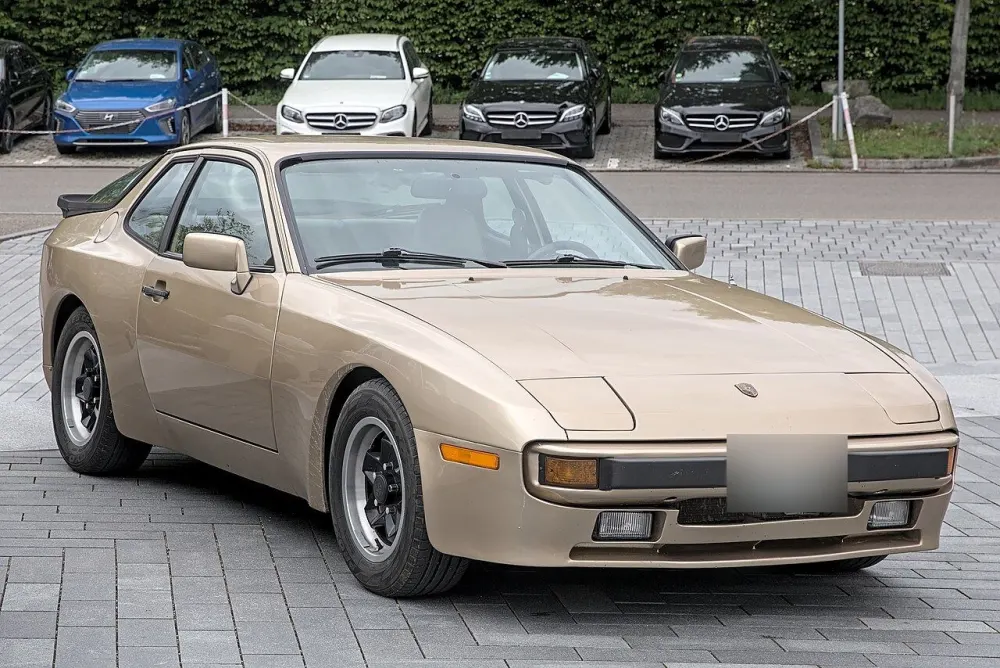
The 944 used a Porsche-built engine and a wider body. Shown at the Frankfurt IAA in September 1981, it had a 2.5-litre four-cylinder with 163 PS under flared wheel arches over the 924 shape.
Porsche describes the engine as derived from the 928's V8, and it is often called "half a 928 V8", although few parts are actually interchangeable. Two balance shafts smoothed out the vibration typical of a big four.
No Porsche had sold so quickly. Porsche counts 30,000 orders in the first production year, and in 1983 the 944 made up around half of the company's output. Turbo (220 PS from 1985), S, S2 and Cabriolet versions followed, and 163,302 944s were built by 1991, at the time the best-selling sports car in Porsche's history.
The later 944s were serious performance cars. Porsche lists 190 PS for the 944 S of 1986, 211 PS for the S2 of 1988 and 250 PS for the 944 Turbo from 1989. A limited 944 Turbo S of 1988 ran to 1,000 cars, and 6,980 944 Cabriolets were built between 1989 and 1991.
What was the Porsche 968?
The 968 was the final evolution of the 924/944 line. It premiered at the IAA in 1991 with a 3.0-litre four-cylinder, 240 PS and 305 Nm, and introduced VarioCam variable valve timing.
Porsche called it the highest-torque naturally aspirated four-cylinder of its time. It was built in Zuffenhausen, cost DM 89,900 in Germany, and arrived in the middle of Porsche's early-1990s crisis (see how the Boxster and Cayenne saved Porsche). Production ended in mid-1995 with 11,245 cars according to Porsche's 968 press kit; a 2026 Porsche retrospective gives 11,248.
How many Porsche transaxle cars were built?
Using the totals in Porsche's transaxle press kits, about 386,000 cars over two decades.
| Model | Production | Launch engine | Launch power | Built (Porsche) |
|---|---|---|---|---|
| 924 | 1976–1988 | 2.0-litre four | 125 PS | 150,684 |
| 928 | 1977–1995 | 4.5-litre V8 | up to 240 PS | 61,056 |
| 944 | 1981–1991 | 2.5-litre four | 163 PS | 163,302 |
| 968 | 1991–1995 | 3.0-litre four | 240 PS | 11,245 |
When the 928 and 968 bowed out in 1995, the 911 was left to carry the brand on its own until the Boxster arrived in 1996; the 911 itself only turned to water cooling in 1997 (see air-cooled vs water-cooled 911). Place the transaxle cars in context on the Porsche origins timeline, then test yourself in the Porsche quiz.
FAQ
Which Porsches are transaxle cars?
The 924, 928, 944 and 968, built between 1976 and 1995. All have a front-mounted, water-cooled engine and the gearbox at the rear axle.
Was the Porsche 924 really a Volkswagen?
It began as Volkswagen development order EA 425 in 1972. VW cancelled the project in late 1974, Porsche bought the design and sold it as a Porsche, built at the Audi plant in Neckarsulm with many VW Group parts.
Did the Porsche 928 win Car of the Year?
Yes. The 928 won the Car of the Year award in 1978 and remains the only sports car to have won it.
Is the 944 engine half of the 928 V8?
Porsche describes it as derived from the 928's V8, and it is commonly called half a 928 engine. In practice few parts are shared, and the 944 four adds two balance shafts.
How many Porsche 968s were built?
Porsche's 968 press kit gives 11,245 cars built in Zuffenhausen from 1991 to mid-1995. A later Porsche retrospective gives 11,248.
Sources
- Time lapse: Porsche's transaxle models, Porsche Newsroom
- Porsche 924, Porsche Newsroom (transaxle press kit)
- Porsche 928, Porsche Newsroom (transaxle press kit)
- Porsche 944, Porsche Newsroom (transaxle press kit)
- Porsche 968, Porsche Newsroom (transaxle press kit)
- Why is the transaxle concept still so fascinating today?, Porsche Newsroom
- Celebrating the Porsche 928, Classic & Sports Car
- Porsche 924, Wikipedia
Every figure here was checked against at least two independent sources, listed at the end.