Models
Porsche 959 history: from Group B study to Paris–Dakar winner
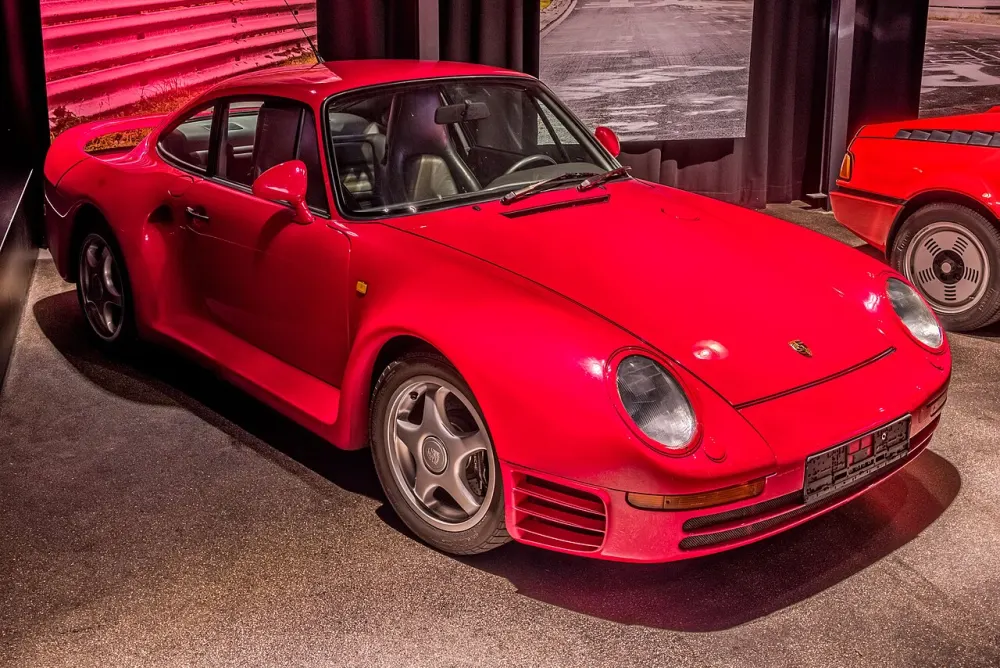
The Porsche 959 began as a Group B study at the 1983 Frankfurt IAA, won the 1986 Paris–Dakar and reached customers in 1987 with 450 PS, sequential twin turbos and electronically controlled all-wheel drive.
By the My Hangar editorsPublished 6 min read
Key takeaways
- Porsche first showed the 959 concept as the "Gruppe B" study at the Frankfurt IAA in autumn 1983.
- A 959 driven by René Metge and Dominique Lemoyne won the 1986 Paris–Dakar Rally, with Jacky Ickx and Claude Brasseur second in another 959.
- The road car used a 2.85-litre flat-six with sequential twin turbos, rated by Porsche at 450 PS, and reached 315 km/h.
- Porsche quotes 292 production 959s built in 1987 and 1988, in Komfort and Sport versions.
- The 959 was never certified for sale in the US; the Show or Display rule that took effect on 13 August 1999 later allowed restricted imports.
The Porsche 959 was Porsche's 1980s technology flagship: a 450 PS twin-turbo flat-six with electronically controlled all-wheel drive and a top speed of 315 km/h. It started as a Group B study at the 1983 Frankfurt IAA, won the 1986 Paris–Dakar one-two before any customer had one, and was built as 292 production cars in 1987 and 1988, by Porsche's count.
Why did Porsche build the 959?
To compete under the new Group B rules for rallying and GT racing, which required 200 road cars for homologation. Porsche showed a study called "Gruppe B" at the Frankfurt IAA in autumn 1983, combining a twin-turbo flat-six, electronically controlled four-wheel drive and a light body with plastic panels.
The project grew into a rolling laboratory for everything Porsche wanted to prove. The production 959 premiered at the 1985 IAA, but development problems pushed first customer deliveries to 1987, four years after the study. By then the reason for the car had gone: Group B rallying was abandoned after 1986, and the 959 never contested the World Rally Championship.
How did the 959 win the Paris–Dakar?
At the second attempt. Porsche used the rally raid as its proving ground for four-wheel drive: in 1984 René Metge and Dominique Lemoyne had already won the Paris–Dakar in the 953, a heavily modified 911 Carrera 4x4 that served as a test bed for the 959's drive system.
In 1985 Porsche entered three 959-bodied rally cars, and none finished; one retired with an oil-line failure and two crashed. The cars then won the Rallye des Pharaons in Egypt that October.
In 1986 the 959 came good. Metge and Lemoyne won the Paris–Dakar again, Jacky Ickx and Claude Brasseur finished second in another 959, and a third car, running as a fast service vehicle, finished sixth.
| Event | Car | Result |
|---|---|---|
| Paris–Dakar 1984 | 953 (911 Carrera 4x4) | 1st, Metge / Lemoyne |
| Paris–Dakar 1985 | 959 rally car, three entered | No finishers |
| Rallye des Pharaons 1985 | 959 rally car | Win |
| Paris–Dakar 1986 | 959 | 1st Metge / Lemoyne, 2nd Ickx / Brasseur, 6th service car |
| Le Mans 1986 | 961 (racing 959) | 7th overall, Metge / Ballot-Léna |
The 961 at Le Mans
A circuit version, the 961, raced at Le Mans in 1986 with René Metge and Claude Ballot-Léna and finished seventh overall, the first all-wheel-drive car to finish the race. It was the only entry in its IMSA GTX class. In 1987 it crashed and burned. For context, Porsche's Le Mans winners of that era were Group C cars; see the Porsche 956 and 962.
How did the 959's all-wheel drive and twin turbos work?
The engine was a 2,849 cc flat-six derived from Porsche's racing units, with an air-cooled block and water-cooled cylinder heads. Its two turbochargers worked sequentially, not in parallel: a smaller turbo did the work at low revs, and the second joined higher up, at about 4,200 to 4,300 rpm depending on the source. The result was strong pull with less lag than one big turbo.
The four-wheel drive was called PSK (Porsche-Steuer-Kupplung, "Porsche control clutch"). Instead of a centre differential, a computer-controlled multi-plate clutch varied the torque sent to the front axle. On slippery surfaces it could split drive roughly evenly; under hard acceleration it could send up to 80 per cent to the rear. Lessons from this system flowed into the 911 Carrera 4 of 1988 (the 964 generation); see our guide to 911 generations.
| Specification | Porsche 959 |
|---|---|
| Engine | 2.85-litre (2,849 cc) flat-six, sequential twin turbos |
| Output | 450 PS (331 kW) at 6,500 rpm |
| Torque | 500 Nm at 5,000 rpm |
| Gearbox | Six-speed manual |
| Drive | PSK electronically controlled all-wheel drive |
| Drag coefficient | 0.31 |
| Top speed | 315 km/h (Porsche figure) |
British magazines quote 444 bhp, which is the same output measured in imperial horsepower rather than metric PS. The body was a light steel structure with aluminium doors and front lid and panels in composite materials, including aramid.
How many Porsche 959s were built?
Porsche quotes 292 production cars, built in 1987 and 1988 in two versions: the Komfort, with adaptive damping and a speed-dependent ride-height system, and the Sport. Broader counts that include prototypes and pre-production cars reach about 337, and Porsche assembled a further eight Komfort cars from spare parts in the early 1990s.
Demand far exceeded supply: Porsche notes that cars changed hands on the open market for more than double the list price.
Why was the 959 not sold in the US?
Porsche never certified the 959 for US sale. It was engineered and tested to European standards, and federalising a car built in such small numbers would have been lengthy and costly. Without US certification, a 959 could not be legally imported for road use.
That changed with the US Show or Display rule, which took effect on 13 August 1999. It lets a collector import a car not built to US standards if regulators accept that it is historically or technologically significant and fewer than 500 were made. Approved cars may be driven at most 2,500 miles (about 4,000 km) a year and must still meet the emissions rules for their model year.
The rule is often linked to Bill Gates, whose 959 is widely reported to have been held by US Customs for years. California specialist Bruce Canepa is also credited with a long campaign to make the 959 eligible, and his shop later offered upgrades so the cars could meet US emissions rules. Neither story changes the legal point: the 959 entered the US through an exemption, not through certification.
Test yourself on the 959 and its successors in the daily Porsche quiz, or see where it sits on the Porsche timeline.
FAQ
How many Porsche 959s were made?
Porsche quotes 292 production cars built in 1987 and 1988. Including prototypes, pre-production cars and eight cars assembled from parts in the early 1990s, other counts reach about 345.
How fast is a Porsche 959?
Porsche gives a top speed of 315 km/h (about 196 mph) for the 450 PS car, which made it one of the fastest production cars of its time.
Did the Porsche 959 win the Paris–Dakar?
Yes. In 1986 René Metge and Dominique Lemoyne won in a 959, with Jacky Ickx and Claude Brasseur second in another. In 1985 all three 959 entries had retired.
Was the Porsche 959 a Group B car?
It was designed for Group B and first shown as the "Gruppe B" study in 1983, but it never raced in the World Rally Championship because Group B rallying ended after 1986.
Is the Porsche 959 legal in the US?
Not as a certified car. Since the Show or Display rule took effect in 1999, approved 959s can be imported, limited to 2,500 miles a year and subject to emissions rules.
Sources
- Forty years since the world premiere of the 959, Porsche Newsroom
- 75 years of Porsche sports car motorsport, Porsche Newsroom
- Porsche 959: review, history and specs, evo
- Bruce Canepa and the story of the 959 in America, FlatSixes
- Car of the Day: 1985 Porsche 959 Paris-Dakar, Supercars.net
- Show or Display, Wikipedia
- Porsche 959, Wikipedia
Every figure here was checked against at least two independent sources, listed at the end.