History
Porsche 356 history: from the Gmünd sawmill to Zuffenhausen
The 356 "No. 1" Roadster got its road permit on 8 June 1948 in Gmünd, Austria. About 52 aluminium cars followed there before Zuffenhausen built some 78,000 356s up to 1965.
By the My Hangar editorsPublished 7 min read
Key takeaways
- The 356 "No. 1" Roadster, the first car to carry the Porsche name, received its road permit in Carinthia on 8 June 1948.
- Porsche says 52 rear-engined 356/2 cars, 44 coupés and 8 cabriolets, were hand-built with aluminium bodies in Gmünd up to 1950.
- The first 356 built in Stuttgart-Zuffenhausen was completed on 6 April 1950, with steel bodies from the neighbouring coachbuilder Reutter.
- The 356 evolved through the 356 A (1955), 356 B (1959) and 356 C (1963) before production ended in 1965.
- Porsche puts total 356 production at about 78,000 cars; Ferry Porsche had originally expected to sell around 500.
The Porsche 356 is the first production Porsche. The one-off 356 "No. 1" Roadster received its road permit on 8 June 1948 in Gmünd, Austria, where about 52 aluminium-bodied 356/2 coupés and cabriolets were hand-built until 1950. Production then moved to Stuttgart-Zuffenhausen, and by 1965, after the 356 A, B and C, Porsche had built some 78,000 cars.
Who founded Porsche, and why was the first car built in Gmünd?
Ferdinand Porsche founded the company in Stuttgart in 1931, but the war pushed it to Austria, where the first Porsche was built. He set it up as an engineering office, not a car maker. "Dr. Ing. h.c. F. Porsche GmbH" was entered in the Stuttgart commercial register on 25 April 1931, with offices at Kronenstraße 24.
For its first 17 years the firm designed engines and vehicles for other companies. In 1938 it moved into its own building in Stuttgart-Zuffenhausen, the site Porsche still calls Werk 1. His son Ferry Porsche worked in the office from the start and would later turn it into a car brand.
As Allied bombing of Stuttgart intensified, the design office moved in 1944 to a former sawmill in Gmünd, in the Austrian province of Carinthia, where around 300 people worked.
After the war Ferdinand Porsche was detained by the French from December 1945. With their father absent, Ferry Porsche and his sister Louise Piëch kept the business going. A Grand Prix car commission from the Italian firm Cisitalia, the Type 360, brought in money, and Ferry pursued his own idea for a light sports car. The project was given design number 356.
What was the 356 "No. 1" Roadster?
It was the first car to carry the Porsche name, and it remained a one-off. The Carinthian state government granted it a road permit on 8 June 1948, the date Porsche treats as the birth of the brand.
No. 1 had an aluminium body on a tubular steel frame. Its engine was a Volkswagen-based flat-four mounted ahead of the rear axle, making it a mid-engined car.
| 356 "No. 1" Roadster | Figure |
|---|---|
| Road permit | 8 June 1948 |
| Chassis number | 356-001 |
| Engine | 1,131 cc air-cooled flat-four, VW-based |
| Power | 35 PS (26 kW) |
| Weight | 585 kg |
| Top speed | 135 km/h |
The production 356 changed the layout. Moving the engine behind the rear axle freed space for two small rear seats and luggage, and that rear-engined template carried straight on into the 911.
How many 356s were built in Gmünd?
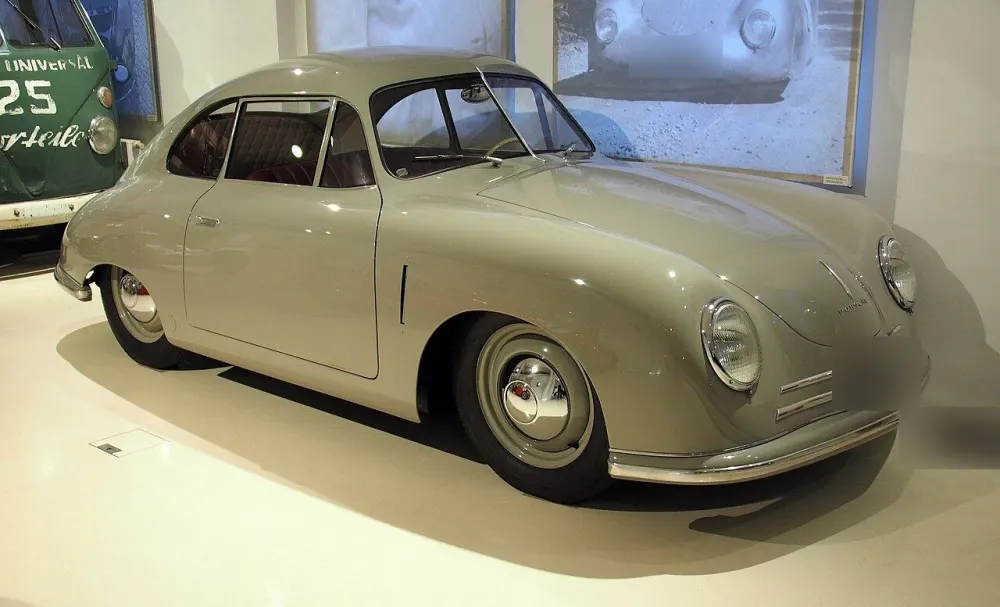
Porsche says 52: 44 coupés and 8 cabriolets of the 356/2, built from winter 1948/49 until Austrian production ended in 1950. Some registries count slightly differently, depending on whether they include later racing coupés built on Gmünd chassis.
The 356/2 used a steel box-section chassis with the engine behind the rear axle and around 40 PS. The first coupé was finished in August 1948, and the car made its international debut at the Geneva Motor Show in spring 1949.
Every Gmünd body was hand-beaten from aluminium sheet, partly by outside coachbuilders, so no two are quite identical. That rarity, plus the Austrian address, is why "Gmünd coupé" carries so much weight with collectors today.
When did 356 production move to Stuttgart-Zuffenhausen?
In 1950. The first 356 built in Zuffenhausen was completed on 6 April 1950, and by the end of that year Porsche had built 317 cars.
Porsche's own Werk 1 was still held by the US military, so the company rented space at Reutter's Werk II across the street for engines and assembly. Reutter built the bodies, now in steel rather than aluminium. Porsche put up a new Werk 2 in 1952, returned to Werk 1 at the end of 1955, and bought Reutter's body plant on 1 December 1963.
Ferdinand Porsche did not see the growth. He died in Stuttgart on 30 January 1951, and Ferry led the company from then on. That same year a lightweight 356 SL won the 1.1-litre class at Le Mans, the start of Porsche's unbroken presence at the race (see Porsche's Le Mans wins).
America mattered quickly. New York importer Max Hoffman began selling the 356 after talks at the 1950 Paris Motor Show; Porsche says US deliveries reached 1,514 in 1955, more than half of its total sales.
What changed between the 356, 356 A, 356 B and 356 C?
Each step kept the shape and the air-cooled flat-four but refined almost everything else. The quickest way to tell them apart is by windscreen, bumpers and brakes.
| Series | Introduced | Key changes | Power range (Porsche) |
|---|---|---|---|
| 356 ("pre-A") | 1948/1950 | Split windscreen, then a bent one-piece screen from model year 1952 | 35 PS (No. 1) upwards |
| 356 A | September 1955 | Curved one-piece panoramic windscreen; 1.3 and 1.6-litre engines | 44 to 100 PS |
| 356 B | September 1959 | Revised T5 body; T6 update with wider front lid from September 1961 | 60 to 140 PS |
| 356 C | September 1963 | Disc brakes on all four wheels as standard | 75 to 130 PS |
The top figures in each row are the four-cam Carrera models. The last 356 C was delivered in May 1966, according to Porsche Classic, although series production had ended in 1965 as the 911 took over (see 911 generations explained).
What were the 356 Speedster and the 356 Carrera?
They were the two cars that gave the 356 its legend: one cheap and open, one fast and complex.
Speedster
The Speedster arrived in late 1954 at Hoffman's urging: a stripped-back open 356 with a low, raked windscreen and a simple folding top, aimed squarely at American buyers. Porsche says 1,033 were sold in 1955 alone. Total production figures quoted by registries and auction houses vary, at roughly 4,800 to 4,900 cars, so treat any single number with care. The Convertible D replaced it in 1958/59.
Carrera
The Carrera put a racing engine in a road car. Ernst Fuhrmann's flat-four, with two overhead camshafts per cylinder bank (Type 547), had first appeared in the 550 Spyder race car shown at the 1953 Paris Motor Show. In the 356 A 1500 GS Carrera, launched with the 356 A in 1955, it made 100 PS. The name honoured Porsche's class successes in the Carrera Panamericana road race in Mexico, and it has marked the fastest Porsches ever since (see Porsche names explained).
The four-cam engine grew to 2.0 litres in the 356 B 2000 GS Carrera 2, with up to 140 PS in GS-GT form, and finished with 130 PS in the 356 C 2000 GS Carrera.
How many Porsche 356s were made?
Porsche puts the total at about 78,000 cars between 1948 and 1965. Some other references give slightly lower figures, around 76,000, depending on how prototypes, racing cars and the final cars delivered in 1966 are counted. Ferry Porsche had expected to sell about 500.
You can follow every step from Gmünd to Zuffenhausen on the Porsche origins timeline, then check how much stuck in today's Porsche quiz.
FAQ
What was the first Porsche car?
The 356 "No. 1" Roadster, chassis 356-001, was the first car to carry the Porsche name. It received its road permit from the Carinthian state government on 8 June 1948 and remained a one-off.
Why were the Gmünd 356s made of aluminium?
The Gmünd cars were hand-built in tiny numbers in post-war Austria, and their bodies were hand-formed from aluminium sheet. When series production moved to Zuffenhausen in 1950, Reutter switched to steel bodies.
How many Porsche 356s were built in Gmünd?
Porsche says 52 rear-engined 356/2 cars: 44 coupés and 8 cabriolets, built from winter 1948/49 to 1950. The No. 1 Roadster is counted separately.
Was the Porsche 356 rear-engined or mid-engined?
The production 356 was rear-engined, with its flat-four behind the rear axle. Only the one-off No. 1 Roadster had its engine ahead of the rear axle.
How many Porsche 356s were made in total?
Porsche gives about 78,000 cars built from 1948 to 1965. Some sources quote around 76,000, depending on what they count.
Sources
- Porsche 356 "No. 1" Roadster, Porsche Newsroom (Porsche Museum press kit)
- Made in Austria: the 356 in Gmünd, Porsche Newsroom
- 75 years of production in Zuffenhausen, Porsche Newsroom
- 90 years of Porsche Engineering, Porsche Newsroom
- Heritage timeline, Porsche AG Investor Relations
- Porsche in America: a history review, Porsche Newsroom
- Porsche 356 A, B and C model pages, Porsche Classic
- The history of Porsche, Volkswagen Group
Every figure here was checked against at least two independent sources, listed at the end.