History
Why is the Porsche 911 called 911 and not 901?
Porsche showed the car as the 901 in 1963, but in October 1964 Peugeot objected: in France it claimed rights to three-digit names with a zero in the middle. So the 901 became the 911.
By the My Hangar editorsPublished 6 min read
Key takeaways
- Porsche presented its new sports car at the Frankfurt IAA on 12 September 1963 under the name Porsche 901.
- Peugeot objected in early October 1964 because it claimed the rights in France to car names of three digits with a zero in the middle.
- Ferry Porsche ordered the name change on 22 October 1964, and the zero was simply replaced by a one: 901 became 911.
- According to Porsche, 82 cars were produced under the 901 designation before the change.
- The four-cylinder sister model was planned internally as the 902 and went on sale in 1965 as the 912.
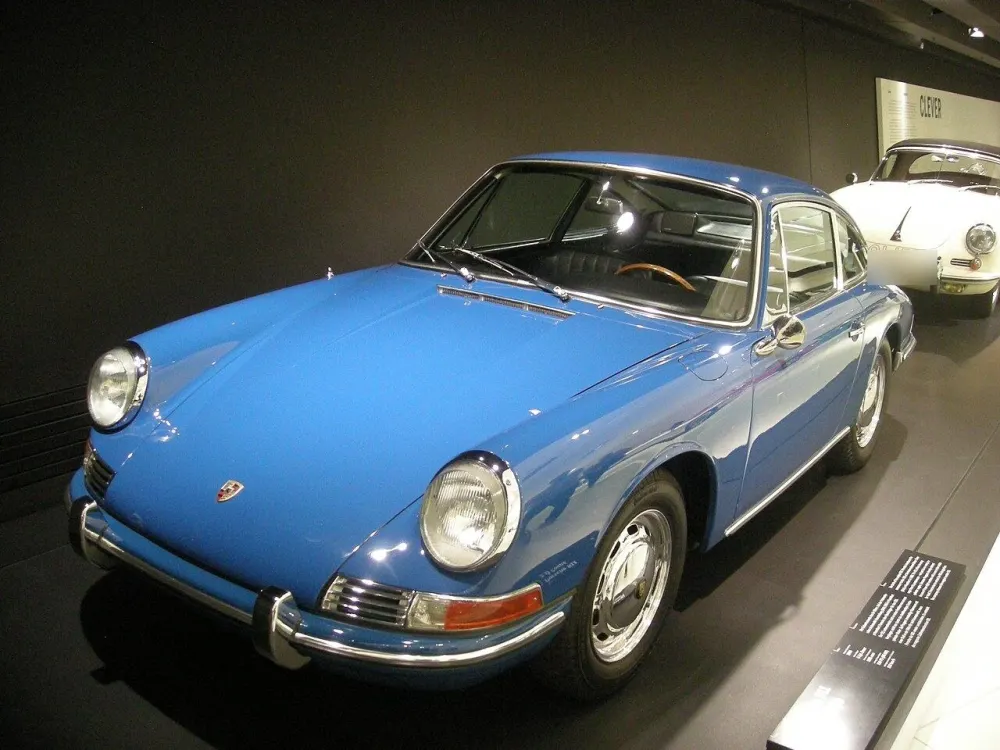
The Porsche 911 was meant to be the 901. It was presented under that name at the Frankfurt IAA on 12 September 1963, and series production began on 14 September 1964. In early October 1964 Peugeot objected: in France it claimed three-digit car names with a zero in the middle. On 22 October 1964 Ferry Porsche ordered the change: the zero became a one, and the 901 became the 911.
When was the Porsche 901 unveiled?
At the Frankfurt motor show (IAA) on 12 September 1963. It was the long-awaited successor to the 356: a 2+2 fastback coupé with a 2.0-litre air-cooled flat-six in the tail.
The shape was drawn by Ferdinand Alexander "Butzi" Porsche, Ferry Porsche's eldest son. The car shown in Frankfurt was a pre-series vehicle, and it took another year to reach production. The engine was entirely new: a 1,991 cc air-cooled flat-six with dry-sump lubrication and one camshaft per cylinder bank, producing 130 PS at 6,200 rpm. It drove through a new five-speed gearbox.
From 356 successor to 901
The brief was evolution, not revolution. Ferry Porsche's own wish list asked for two seats plus two comfortable occasional seats and easier entry, while the sales department wanted to keep the familiar Porsche line. Several outside designers submitted proposals, but Ferry rejected them as not being a Porsche. The breakthrough came in 1959, when F.A. Porsche produced a model of a coupé close to his father's ideas.
An early four-seat study followed, but Ferry insisted on a fastback, so the car became a 2+2. Development of the production car began in 1962, and the first 901 prototype drove out of the Zuffenhausen gates on the evening of 9 November 1962. To make series production possible, Porsche took over its body supplier Reutter in 1963.
"901" was not a random marketing number. It was the car's type number in Porsche's internal sequence of design projects, the same system that gave the 356 its name.
Why did Peugeot object to the name 901?
Because Peugeot had been naming its cars with three digits and a central zero since the 201, launched at the Paris Salon in October 1929. The 301 and 401 followed, and post-war models such as the 404 kept the pattern. Peugeot claimed the exclusive right to that pattern in France, so a Porsche "901" sold there would have fallen inside it.
Porsche's own account says its development department had researched the name in advance. Peugeot's argument was not about the number 901 itself but about the principle of the middle zero. The objection reached Porsche in early October 1964, around the car's appearance at the Paris Motor Show.
Porsche could, in theory, have used a different name only in France. It chose instead to rename the car 911 for every market.
How did the 901 become the 911?
By changing one digit: the middle zero became a one. Ferry Porsche gave the order on 22 October 1964.
Porsche's own histories differ on who had the idea. One credits chief designer F.A. Porsche, who simply doubled the "1"; another says the sales management team proposed it. Both agree on the main advantage: swapping a single character meant the print layouts already prepared for brochures, advertising and owner's manuals did not have to be redone.
The timing was awkward. The "901" lettering had already been designed and the first posters and brochures had been printed. Production had started on 14 September 1964, so the first cars had been built as 901s.
The old number did not vanish. The engine and many part numbers kept the 901 prefix, and enthusiasts still call the early 911 gearbox the "901" transmission.
How many Porsche 901s were built?
Porsche's classic pages say 82 cars were produced as 901s before the name changed. They were built between 14 September and mid-November 1964. According to the Porsche Museum, customer cars made up to that point were manufactured as 901s but sold as 911s.
| Date | Event |
|---|---|
| 12 Sep 1963 | Porsche 901 premieres at the Frankfurt IAA |
| 14 Sep 1964 | Series production of the 901 begins in Zuffenhausen |
| Early Oct 1964 | Peugeot objects to the middle-zero name |
| 22 Oct 1964 | Ferry Porsche orders the change to 911 |
| Apr 1965 | Four-cylinder 912 (planned as the 902) goes on sale |
One survivor is now famous. Chassis 300 057, known as "Number 57", was taking shape on the production line on 22 October 1964, the very day the name changed. It was found in a barn in Brandenburg in 2014 by a television crew, bought by the Porsche Museum for EUR 107,000 and restored over three years before going on display in December 2017. You can see where it sits in the story on the My Hangar Porsche timeline.
Why are the 912, 914 and 924 numbered the way they are?
Because Porsche kept using its type numbers as model names, but stopped putting a zero in the middle of road-car names.
- 912: the four-cylinder version of the new car was developed alongside the 901 as the 902. It never went on sale under that name; it arrived in April 1965 as the 912, with the 356's 1.6-litre four-cylinder and 90 PS.
- 914: the mid-engined sports car developed with Volkswagen and shown at the 1969 IAA was sold as the 914/4 and 914/6.
- 924: the front-engined, water-cooled entry model of 1975 was also named after its internal type number.
The middle zero did survive on the race track. Porsche's 1960s competition cars carried type numbers 904, 906, 907, 908 and 909, but the road-legal 904 was sold as the Carrera GTS and the 906 as the Carrera 6. If you want to know what those names mean, see Porsche names explained.
Did the 911 name come from the US emergency number?
No. The name was settled in October 1964, while AT&T only announced 911 as an emergency number for the United States in January 1968, and the first 911 call was made in Haleyville, Alabama, on 16 February 1968. The 911 name is older than the American emergency number.
Test your memory of these dates in the My Hangar Porsche quiz, and follow the car's evolution in Porsche 911 generations explained.
FAQ
What was the Porsche 911 originally called?
The Porsche 901. It was shown under that name at the Frankfurt IAA in September 1963, and the first production cars were built as 901s from 14 September 1964.
Why did Porsche change the name from 901 to 911?
Peugeot objected because it claimed the rights in France to car names made of three digits with a zero in the middle. Porsche replaced the zero with a one and renamed the car 911 for all markets.
How many Porsche 901s were made?
Porsche puts the figure at 82 cars produced under the 901 designation before the name changed in autumn 1964.
Was the 912 ever called 902?
Only internally. The four-cylinder model was developed as the 902 alongside the 901, but it was launched in 1965 as the 912 and never sold as a 902.
Sources
- 1963: The middle zero moment, Porsche Newsroom
- Evolutionary history of the 911: from Type 754 to 901, Porsche Newsroom
- Porsche 901, Porsche Classic (Porsche Cars North America)
- Restoration of Number 57, Porsche Newsroom
- Porsche four all: celebrating the 912E, 912 and 914, Classic & Sports Car
- Axon's Automotive Anorak: Peugeot, 90 years of naming by number, Goodwood Road & Racing
- 50 years of 911: the small town that revolutionized emergency response, UPI
- Porsche 911 (classic), Wikipedia
Every figure here was checked against at least two independent sources, listed at the end.